From Code Suggestions to File Changes: The Real Boundary of AI Coding Agents
As companies begin to use Cursor, Claude Code, Amazon Q, Windsurf, Augment, and similar AI coding tools in daily development, a familiar assumption often appears: if the model does not directly touch production data, the risk is manageable.
That assumption is too narrow. In real development workflows, an AI coding agent is not only a text generator. It may run local scripts, modify project files, execute tests, call command-line tools, prepare pull requests, or trigger downstream automation. Once an agent has write access to a working environment, the security question changes from “what did the model say?” to “what can the execution chain actually change?”
That is why the recent discussion around GhostApproval matters for enterprise teams. The core lesson is not limited to one technique or one vendor. It is a reminder that attackers can try to turn repository structure, approval wording, path handling, or symbolic links into a way to guide an AI-enabled workflow toward changes outside the intended boundary.
The Threat Model Is Not “The Tool Is Confused”
For enterprise governance, the useful question is not whether a coding assistant can make mistakes. Mistakes are expected. The more important question is whether the surrounding engineering controls can prevent a mistake, malicious instruction, or manipulated repository from becoming a real file-system change outside the approved scope.
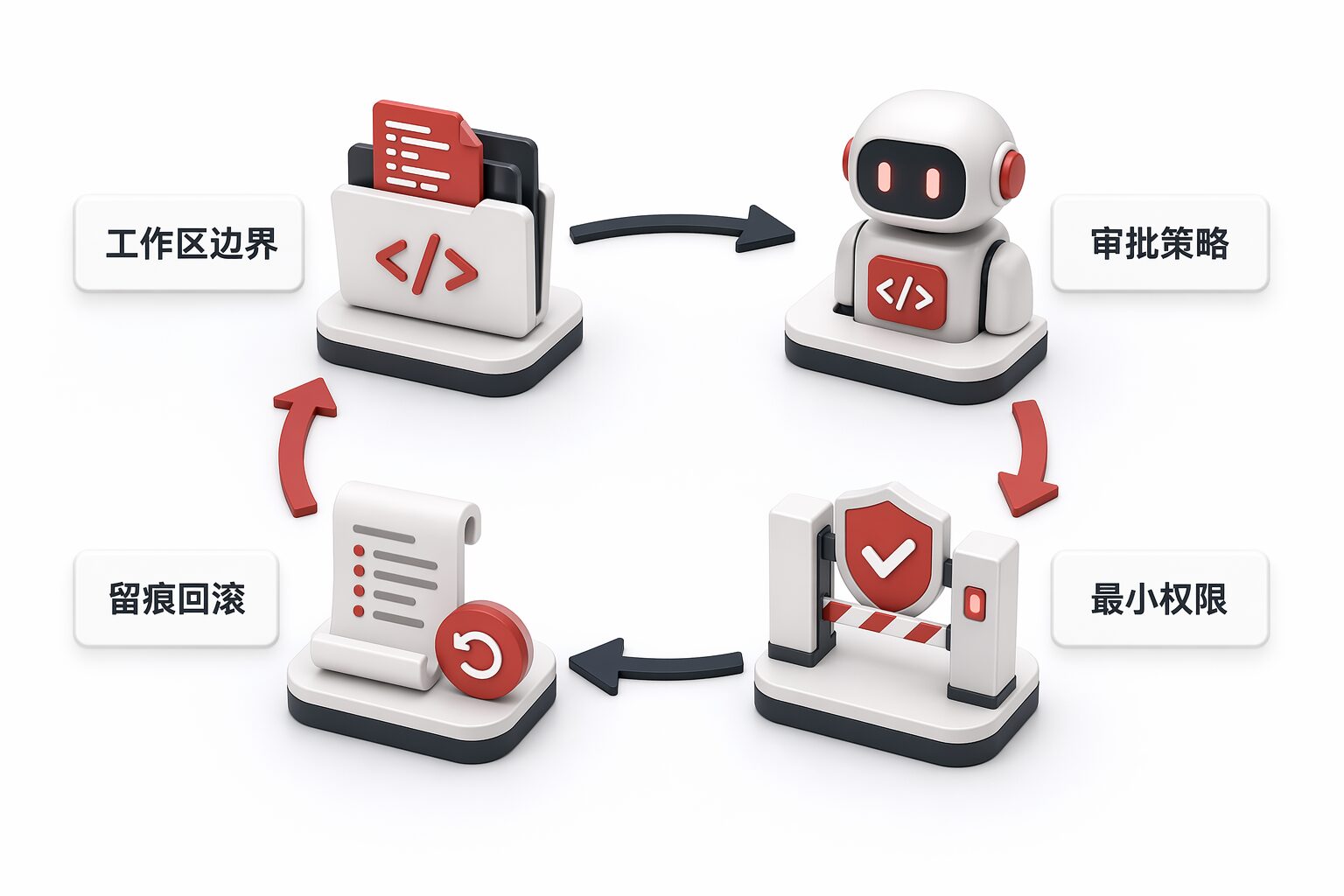
A practical threat model for AI coding agents should include five dimensions:
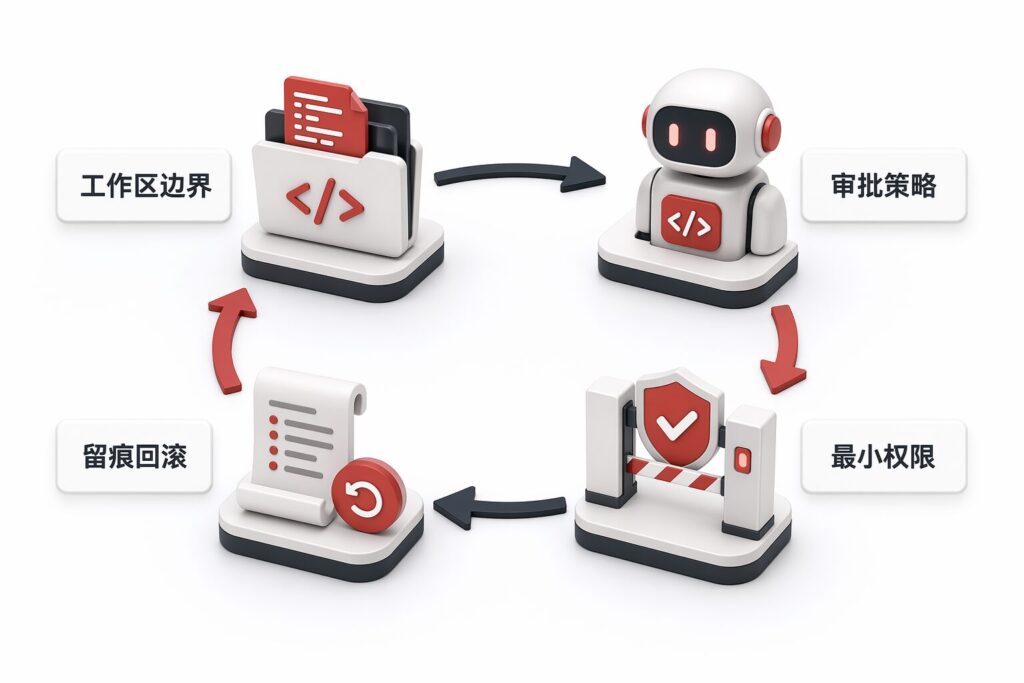
- Workspace boundary: Is the agent limited to a clearly defined working directory? Are symbolic links, mounted paths, generated files, and real paths handled consistently?
- Approval semantics: Does the user see the exact files that will be changed, or only a natural-language description of intent?
- Least privilege: Does the executor run with only the permissions required for the task, or does it inherit broad developer-machine access?
- Auditability: Can the organization reconstruct who initiated the task, what context was used, what files were changed, and which approval step allowed it?
- Recovery: If a change is wrong or malicious, can the environment be rolled back quickly and reliably?
Many organizations start with a simple control: limit which commands the tool can run. That is useful, but incomplete. GhostApproval-style risks sit closer to the implementation layer, where the displayed path, the approved path, and the real write path may not always be the same thing. If those three views diverge, the governance model has a blind spot.
Make the Visible Boundary Match the Actual Write Boundary
A strong enterprise rule is simple to state:
Every write operation must pass through the same real-path normalization and policy evaluation before execution.
This rule matters because file paths are not always as straightforward as they look. Symbolic links can make a file appear to live inside the workspace while the real target points elsewhere. Build scripts can generate files in unexpected locations. Automation can expand templates, follow links, or write through helper tools that are not obvious from the agent’s natural-language plan.
Good governance therefore needs one shared policy layer for display, approval, and execution. The file list shown to the user should be generated from the same real-path logic used by the executor. The executor should then reject any write that falls outside the approved set, even if a later step or helper process attempts it.
Control Area 1: Real-Path Validation and Symbolic Link Policy
The first control area is path governance. Enterprises should normalize every write target before allowing it. This includes resolving symbolic links, checking absolute paths, applying allowlists and denylists, and detecting cross-directory jumps.
In practice, this means:
- Resolve every write target to its real path before approval and before execution.
- Reject writes to sensitive paths such as SSH directories, credential stores, system configuration paths, and shared secrets.
- Apply the same symbolic-link policy in the approval interface and in the executor.
- Log both the displayed path and the resolved real path for later investigation.
This is one of the most important differences between a demo and a production-ready AI coding workflow. In a demo, the agent “works” if it edits a file and passes tests. In production, the workflow is only acceptable if the system can prove that the edit happened within the approved boundary.
Control Area 2: Least Privilege for the Agent Executor
The executor behind an AI coding agent should not behave like a fully trusted developer sitting at a high-privilege workstation. It should run with a limited account, a defined workspace, and minimal access to the host environment.
For enterprise environments, this usually means:
- Use a dedicated low-privilege account or containerized runtime for agent execution.
- Grant write access only to the required project directories.
- Block access to secrets, credential files, deployment keys, personal directories, and system-level configuration.
- Separate network permissions, artifact upload permissions, and CI/CD triggering permissions from basic code-editing capability.
This design reduces blast radius. If a repository contains hostile content, if the model follows a bad instruction, or if an approval step is misunderstood, the executor should still be unable to write to sensitive locations.
Control Area 3: Approval Based on Real Change Sets
Approval should not be reduced to “the user clicked yes.” For AI coding agents, approval must be tied to the real change set. The reviewer should see which files will be changed, where those files resolve on disk, what risk level is attached, and whether the planned operation crosses a boundary.
A stronger approval model has two layers:
- Pre-execution view: show the resolved file list, change summary, and policy decision before the agent writes.
- Execution enforcement: allow only the approved file set at execution time and block anything outside it.
When display and enforcement come from the same policy engine, approval becomes meaningful. When they are separate, the user may approve one thing while the system writes another.
Control Area 4: Audit, Alerting, and Rollback
AI coding governance is not only prevention. It must also support investigation and recovery. Security teams need enough telemetry to answer practical questions quickly:
- Which task, prompt, repository state, and tool invocation led to the write?
- Which files were changed, and what were their resolved real paths?
- Who approved the change, and did the approval match the executed file set?
- Was any boundary-crossing attempt blocked?
- Can the affected workspace, branch, or environment be rolled back?
These logs should feed the enterprise’s existing security operations workflow. Over time, the organization can build a risk profile for AI development activity: which tools are used, which repositories trigger policy violations, which teams require stronger guardrails, and which controls need tuning.
A Practical Rollout Path for Enterprises
Enterprises do not need to solve every problem at once. A workable rollout path can follow five steps:
- Policy definition: define allowed write locations, sensitive path denylists, symbolic-link rules, and approval levels.
- Execution control: implement real-path validation and least-privilege runtime isolation for AI coding workflows.
- Regression testing: test known patterns such as symbolic link redirection, workspace escape attempts, generated-file writes, and unapproved file changes.
- Recovery design: create rollback procedures for local workspaces, branches, CI artifacts, and affected environments.
- Continuous operation: send audit events to the security operations stack and review trends regularly.
This approach turns AI coding risk from a vague concern into a set of enforceable controls. It also gives engineering teams a clear answer when business stakeholders ask whether AI coding tools are ready for broader adoption.
How DELine Can Help
DELine helps organizations move from experimental AI tooling to production-ready AI governance. For AI coding agents, we can support the full path from assessment to implementation:
- AI agent security governance assessment for tools such as Cursor, Claude Code, Amazon Q, Windsurf, and Augment.
- Workspace boundary and permission-control design for enterprise development environments.
- Private or local AI tool deployment security review, including path validation, executor isolation, and audit requirements.
- Security test cases for symbolic link attacks, workspace escape attempts, approval bypass, and rollback validation.
- Integration with enterprise logging, alerting, and operational review processes.
If your organization is preparing to adopt AI coding agents at scale, the right question is not only whether the tool can generate useful code. The real question is whether your environment can control what the agent is allowed to change, prove what it actually changed, and recover when something goes wrong.
DELine can help you build that governance layer around your existing development stack, so AI coding tools become a managed enterprise capability rather than an unmanaged source of operational risk.
Five Checks You Can Run Now
- Do all AI-driven writes go through the same real-path validation?
- Are sensitive paths blocked after symbolic links are resolved?
- Does the executor run with least privilege?
- Can audit logs connect task context, approval, and actual file changes?
- Have rollback procedures been tested, not only documented?
Once these checks are in place, GhostApproval-style risks become governable engineering problems rather than surprises waiting to happen.