Refrigeration systems are now part of the cyber-physical attack surface
A refrigeration controller used to be treated as a facilities asset: important to the store or warehouse, but separate from the organization’s network-security program. Remote monitoring changes that boundary. Once a controller is reachable through a gateway, cloud platform, vendor VPN, or internet-facing management page, credentials, firmware, and network design can affect physical temperature settings, alarms, and business continuity.
On November 5, 2026, CISA, the FBI, the U.S. Departments of Health and Human Services, Agriculture, and Transportation issued joint guidance warning of malicious activity targeting industrial refrigeration and cold-chain monitoring systems globally. The agencies said attackers may exploit unpatched or internet-accessible temperature and commercial-refrigeration controllers through authentication bypass, arbitrary code injection, or weak configurations. Potential effects include altered temperatures, equipment hazards, inventory loss, and loss of visibility into current temperatures. Their joint fact sheet urges operators to review exposed systems and secure remote access.
“Connected refrigerator” can mean two very different things
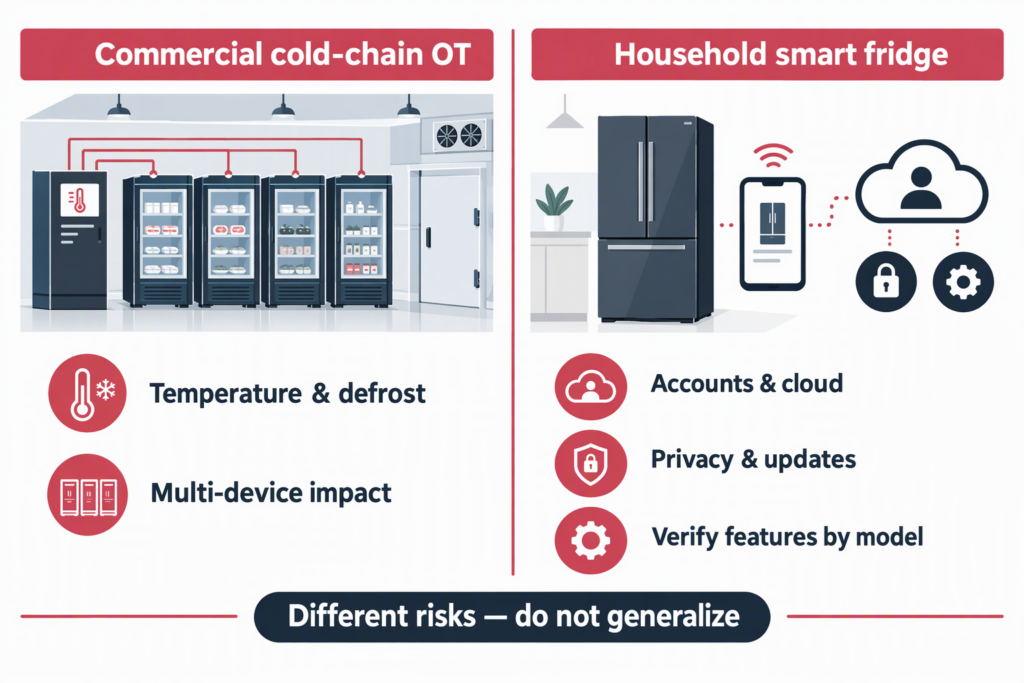
The word “refrigerator” can refer to a household smart appliance or to an industrial/commercial refrigeration installation. Both may use network connections, but their architecture, operational impact, and security priorities are not interchangeable.
| Environment | Typical components | Main security impact | What to check first |
|---|---|---|---|
| Supermarkets, cold stores, food processing, pharmaceutical cold chain | Temperature controllers, field controllers, sensors, gateways, remote-maintenance or cloud platforms | Changed temperature or defrost settings, loss of monitoring, inventory loss, service disruption; product-quality and patient-safety implications in medical settings | Internet exposure, maintenance accounts, firmware support, OT separation, independent temperature alarms |
| Household smart refrigerator | Network module, mobile app, manufacturer cloud service, home router | Account or data exposure is the primary concern; unauthorized setting changes matter only on models with relevant remote-control features | App/cloud account security, update support, remote features, home-network separation, data collection |
A consumer refrigerator’s capabilities vary by model, firmware, and app. “Connected” does not automatically mean an attacker can control its compressor or defrost cycle. Conversely, a supervisory controller in a commercial environment may coordinate multiple cabinets, storage areas, or sites, creating a broader operational blast radius.
Recent incidents show the physical consequences—and the attribution limits
Xinhua reported that French supermarkets suffered a refrigeration-system cyberattack in October 2026, with abnormal temperature changes and losses of fresh and frozen inventory. The report described attackers forcing automatic defrost functions and changing temperature settings, and identified Danfoss refrigeration controls as the target.The Xinhua report was based on reporting and statements from the affected market.
France’s CERT-FR later said it was aware of numerous compromises of remote refrigeration controllers and listed Danfoss AK-SM and AK-SC, Copeland XWEB, and Dixell XWEB families in its security alert. The alert does not name a threat actor or identify a specific CVE used in the intrusions. Separately, Xinhua reported that a French blood-service cold-storage facility detected altered operating parameters through its monitoring system and contained the event without blood-product losses; the report said no evidence linked that incident to the earlier supermarket attacks.The blood-service report
There are documented vulnerabilities in refrigeration controllers. CISA’s 2025 advisory for Danfoss AK-SM 8xxA lists authentication and command-injection/configuration issues in specified versions. Its 2026 Copeland XWEB/XWEB Pro advisory lists issues including authentication bypass, denial of service, memory corruption, and arbitrary code execution in affected versions.Danfoss advisory; Copeland advisory. These advisories establish vulnerabilities in specified products and versions; they do not prove that those CVEs were used in the recent incidents. Vulnerability disclosure and incident attribution are separate evidence questions.
What the available evidence says about China
China’s cold-chain policy has encouraged digitalization. The State Council General Office’s 14th Five-Year Cold-Chain Logistics Plan called for wider use of IoT, 5G, cloud services, temperature monitoring, smart warehousing, transport dispatch, and traceability.The official plan describes an industry direction; it does not provide a current national count of exposed refrigeration controllers, vulnerabilities, or attacks.
A November 2026 Global Times report quoted a Qianxin expert describing a common commercial design in which local refrigeration controllers connect through gateways to cloud or remote-management platforms. The expert warned that some domestic supermarket and cold-store temperature-control devices may be exposed to the public internet, and recommended inventory, access reduction, credential hygiene, patch management, and independent alarms.The report and expert comments. This is a warning worth investigating, not a representative survey or a measured national exposure rate; public data sufficient to quantify the scale was not found in this research.
For household appliances, the 2024 China Smart Appliance Information Security White Paper 2.0 discusses risks across device, communications, application/platform, and data layers, as well as related standards and testing.The white paper supports the broader conclusion that connected appliances need lifecycle security. It is not a market-wide vulnerability census of refrigerator brands or models, and it does not establish that Chinese smart refrigerators are generally remotely exploitable.
This public-source review did not identify a verified large-scale attack on Chinese household smart refrigerators comparable to the reported European supermarket incidents. Nor did it establish that the Danfoss or Copeland commercial-controller vulnerabilities apply to domestic consumer refrigerator products. That is a bounded finding from the sources reviewed—not proof that no risk or undisclosed incident exists. The practical conclusion is to prioritize checks on commercial cold-chain OT while assessing consumer products by exact model, cloud service, and supported remote functions.
The control path is the security boundary
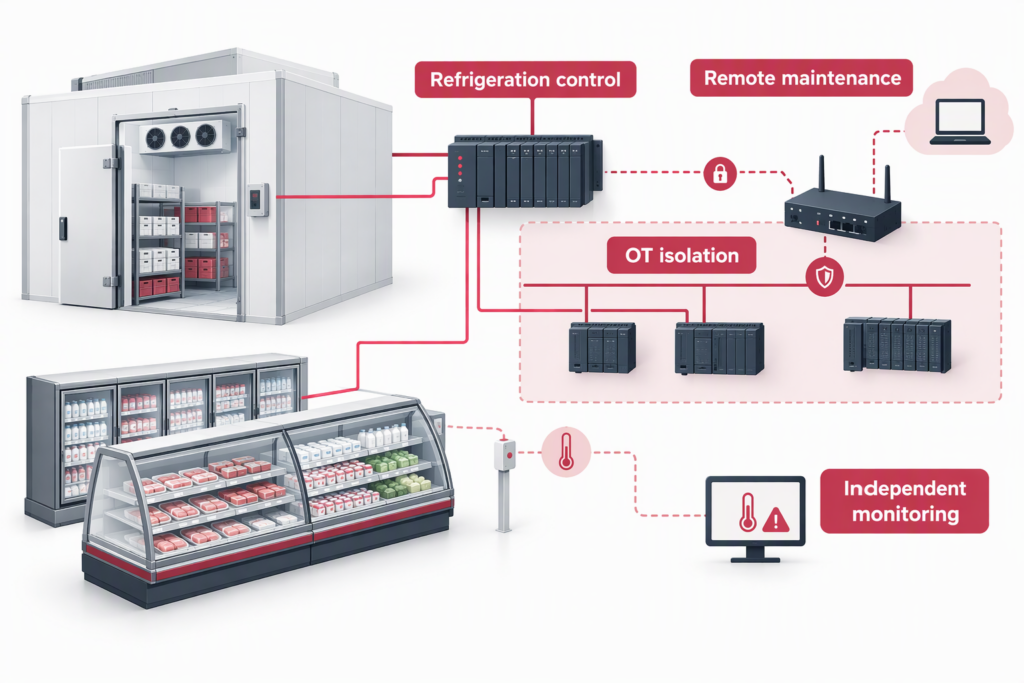
A remote refrigeration-maintenance environment may include temperature sensors, controllers, a gateway or supervisory platform, a vendor-maintenance route, and corporate networks. Remote operations can make multi-site service more efficient, but they also create trust paths: a maintenance account may be able to change operating parameters; a controller may remain unpatched; alarms and control data may depend on the same platform; and responsibility among the operator, contractor, and equipment vendor may be unclear.
The useful questions are operational: Who can change temperature and defrost settings? Is any management page directly reachable from the internet? Is vendor access approved, time-limited, attributable to an individual, and logged? Can an independent sensor raise an alarm if the controller’s own view is unavailable? What happens when a device reaches end of support? These answers determine whether a remote access path can affect physical operations and whether staff can detect an abnormal condition in time.
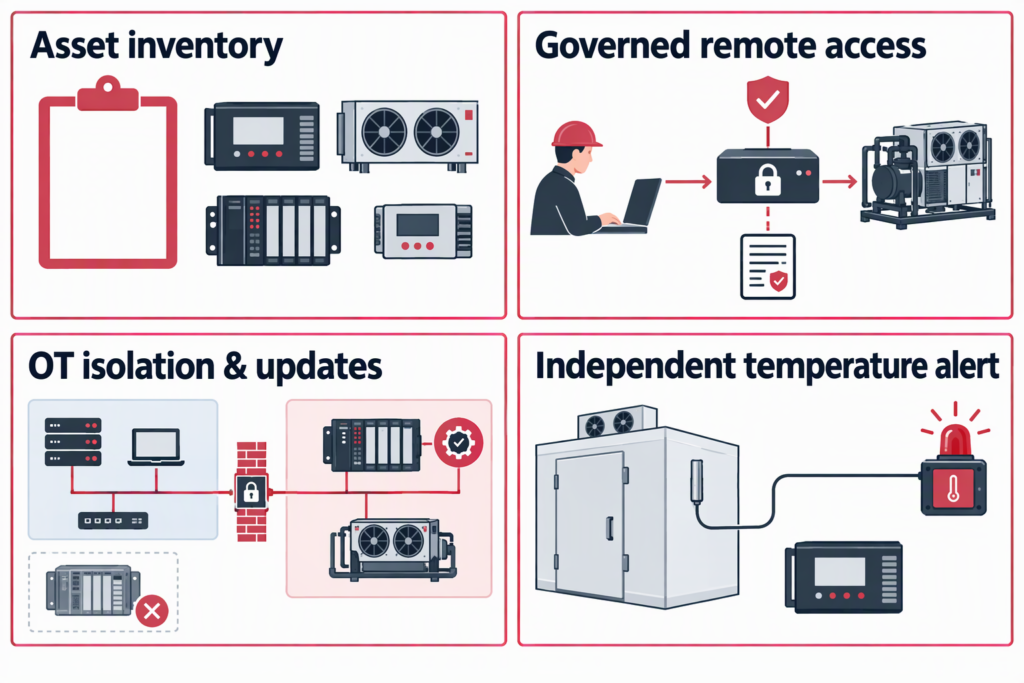
Four groups of controls help make those questions auditable: asset and firmware inventory, governed remote access, OT separation and updates, and independent temperature alarms.
Six controls for commercial refrigeration operators
1. Inventory refrigeration assets. Record controller model and firmware, internet reachability, service provider, accountable owner, connected equipment, and vendor support status across stores, cold rooms, and transport operations. Include gateways, remote-management platforms, and service accounts—not just servers and office endpoints.
2. Remove unnecessary public access. Management interfaces should not be directly exposed to the internet. Where remote maintenance is required, route it through a controlled VPN, firewall, or jump host; restrict source addresses and target devices; require multifactor authentication where feasible; and grant time-limited access tied to a work order. Use individual vendor accounts rather than shared, long-lived administrator credentials.
3. Separate OT from business networks. Place refrigeration control systems in a dedicated network zone and allow only necessary communications. Restrict movement from office endpoints, guest networks, and unrelated IoT devices toward OT assets.
4. Manage firmware and end of life. Check vendor advisories, installed versions, upgrade compatibility, and maintenance windows. For unsupported equipment that cannot be patched, remove internet exposure, strengthen network isolation, and plan replacement. Continued operation does not mean continued vendor security support.
5. Add independent monitoring and safe limits. In addition to controller-native alarms, consider independent temperature probes or monitoring paths that can cross-check readings. Alert responsible staff to threshold breaches, unusual defrost activity, out-of-hours logins, lost connectivity, or unexpected setpoint changes. Verify that a single remote account cannot silently disable all temperature checks.
6. Prepare manual fallback and incident response. Define contacts, on-site inspection, product segregation or transfer, and escalation steps for temperature anomalies, controller outages, or suspected compromise. Preserve configuration backups, access records, network telemetry, and work orders. Assess product disposition against applicable food, pharmaceutical, or medical requirements rather than relying on one system’s display alone.
These actions align with CISA’s guidance on removing public exposure, OT segmentation, credential security, patching and end-of-life replacement, allowlisting, logging, and safe setpoint limits. Adapt them to equipment models, process-safety requirements, product-quality rules, and manufacturer instructions. Do not disconnect, change settings, or reboot a running control system without evaluating operational consequences.
Household users and appliance manufacturers have different priorities
Household users can use a unique password for the refrigerator app, enable multifactor authentication if available, check whether the refrigerator and companion app still receive security updates, disable unnecessary remote features and account sharing, and avoid exposing a management interface through router port forwarding. Before selling or disposing of a connected appliance, sign out and clear its network pairing and personal data according to the manufacturer’s instructions.
Manufacturers should define security-update support periods, vulnerability disclosure and remediation processes, remote-management authorization, account-recovery protections, and data-collection limits. The white paper’s general smart-appliance security requirements and test methods can inform product assurance, but each product still needs verification against its actual model, firmware, and functions. Household refrigerator assessments should not simply copy the industrial-controller remediation checklist.
Treat cold-chain security as control-rights governance
Cybersecurity for refrigeration is not only about protecting data. It is about keeping temperature control, monitoring, and human response trustworthy when something goes wrong. Supermarkets, cold stores, food processors, and pharmaceutical cold-chain operators should begin by identifying assets, reducing remote exposure, checking vendor support, and verifying that abnormal temperatures can be detected independently. Household smart-fridge users should focus on accounts, apps, cloud services, and update lifecycles.
DELine can help organizations inventory refrigeration and cold-chain assets, review remote maintenance and network segmentation, assess OT lifecycle and alerting processes, and develop a phased remediation plan that fits the existing IT environment. Learn about enterprise cybersecurity and ongoing operations at DELine or contact our team.
This article provides technical and management analysis, not a model-specific vulnerability notice or legal opinion. Before making changes, verify asset models, firmware, vendor advisories, and site process-safety requirements.
References
- U.S. government partners: Joint fact sheet on industrial refrigeration and cold-chain monitoring system security
- CISA: Danfoss AK-SM 8xxA Series vulnerability advisory ICSA-25-140-03
- CISA: Copeland XWEB and XWEB Pro vulnerability advisory ICSA-26-057-10
- CERT-FR: Security alert on remote controllers for refrigeration installations, CERTFR-2026-ALE-012
- Xinhua: Cyberattack hits refrigeration systems at hundreds of French supermarkets
- Xinhua: Refrigeration equipment at supermarkets in several European countries targeted
- Xinhua: French blood-service cold storage incident contained after monitoring alerts
- State Council General Office: 14th Five-Year Plan for Cold-Chain Logistics Development
- National Advanced Home Appliance Innovation Center and partners: China Smart Appliance Information Security White Paper 2.0
- Global Times: Experts warn of internet-exposure risks to refrigeration systems
- SC Media: FBI and CISA warn of cyberattacks targeting refrigeration systems