As more enterprises integrate AI into customer service, office automation, R&D collaboration, knowledge retrieval, and even operations orchestration, one pressing question arises: how to deploy AI agents securely without slowing down business or exposing data, accounts, and systems to new attack surfaces? Teams often initially focus only on “can it run?” while ignoring “can it go out of control, leak data, exceed permissions, or misoperate after running?” This is the pitfall many face in AI agent security deployment.
According to the “Network Security Standard Practice Guide – AI Agent Deployment Security Guidelines” (v1.0-202607), security governance should not be limited to the moment of going live but must span the five stages: assessment, preparation, deployment, usage, and deactivation. That is, AI agent security deployment is not a one-time configuration but a continuous security engineering process.
This guide breaks down key standard requirements into actionable steps suitable for IT administrators, security teams, architects, and business leaders planning to bring AI agents into production.
—
### 1. Assessment Phase: Setting the Foundation for 90% of Subsequent Risk
Many enterprises first choose a product before evaluating needs, which often leads to reactive fixes later. The assessment phase focuses on selecting a solution fitting your risk tolerance, emphasizing three key questions:
– What is the业务场景 (business purpose) – simple information summarization or execution-capable agents?
– Where are the data boundaries – public, internal, sensitive, regulated?
– Open source or commercial? Local or cloud-based?
Clear boundary definitions upfront avoid post-deployment chaos like data leaks or unintended actions.
### 2. Preparation Phase: Secure Installation, Environment Isolation, and Model Compliance
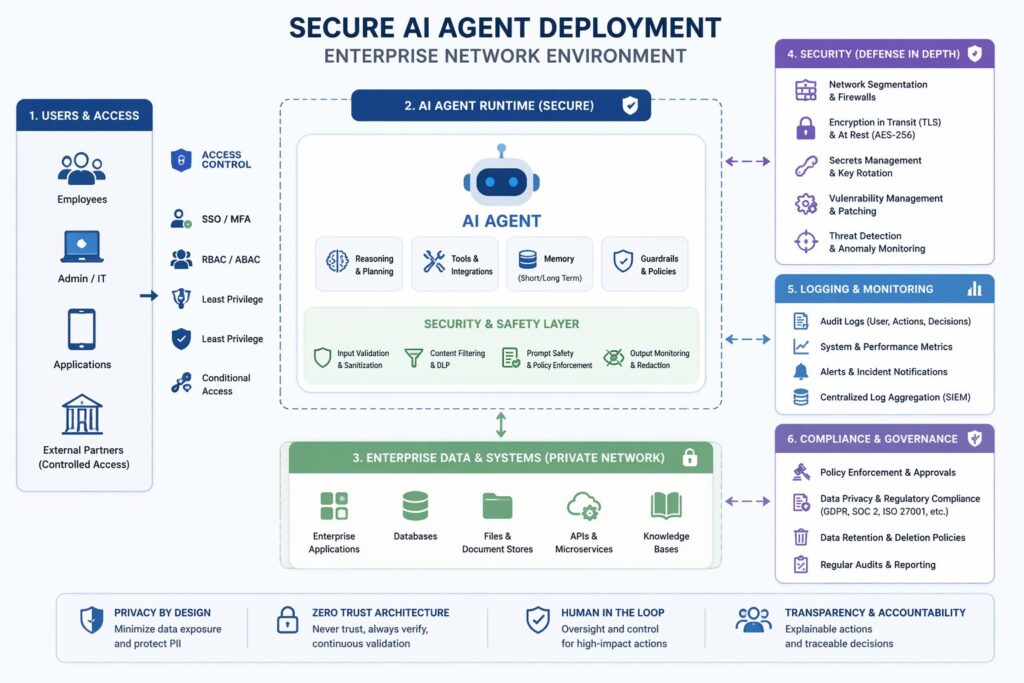
Ensure installation packages are from trusted sources and verified via hash and signatures. Isolate the AI agent environment into interaction, execution, and resource layers with explicit authorization. Manage models and credentials securely, avoiding hard-coded secrets and unauthorized intermediate services.
### 3. Deployment Phase: Enforce Least Privilege, Comprehensive Logging, and Secondary Confirmations
Avoid generic one-line deployment scripts; audit scripts before execution. Enforce least privilege principles to limit damage scope if compromised. Maintain full logs including file operations, network calls, skill invocations, permission changes, and critical operations. Use alerting and rapid termination capabilities to control incidents.
### 4. Usage and Deactivation: Continuous Governance Ensures Long-Term Security
Routine review of logs, permissions, plugins, and API keys is essential. Keep asset registers detailing deployment locations, owners, models, enabled skills, permissions, and data scopes. When decommissioning, properly terminate processes, revoke access keys, clean caches, and retain audit data per compliance.
Frequently Asked Questions address differences from traditional apps, open source vs commercial, cloud compliance, log details, and high-risk operation safeties like secondary confirmations.
For organizations aiming to deploy AI agents securely and efficiently, building a solid foundational framework and continuous governance is more cost-effective than post-incident remediation.
—
Discover comprehensive enterprise-level AI security solutions and practical experience at De-Line Information Technology:
************
The above content is provided by our AI automation poster