
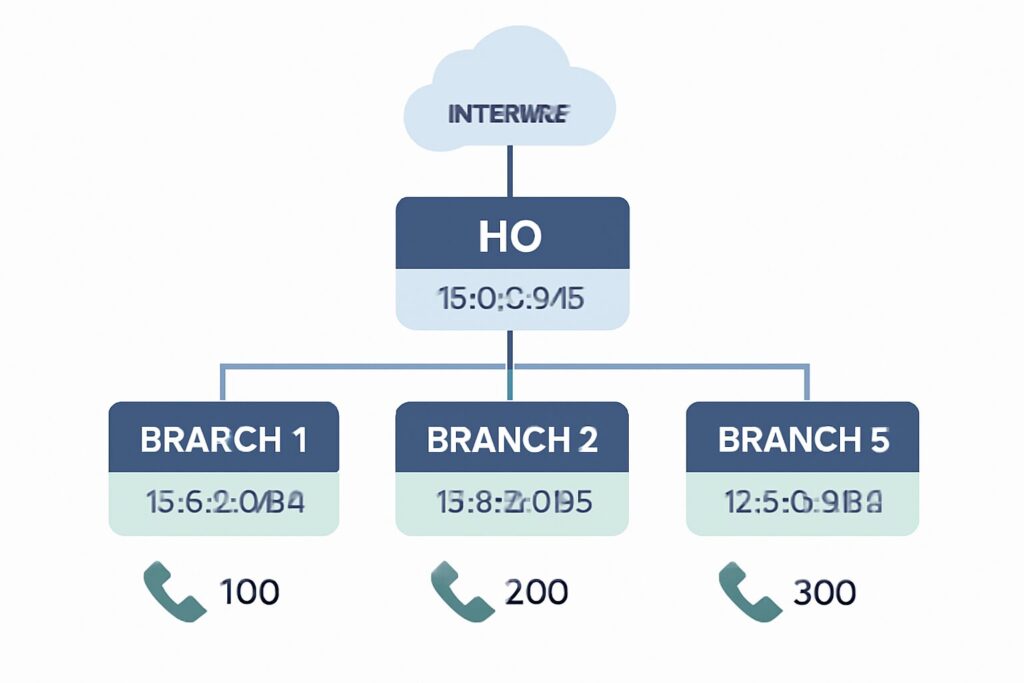
In today’s rapidly advancing digital age, the design of enterprise network architecture is increasingly crucial, especially for large organizations with multiple branches and departments. Internal IP address planning and extension number management are not only the foundation for ensuring network stability but also key to enhancing management efficiency and system scalability. This article delves into how to build a flexible, scalable, and manageable network addressing system alongside efficient telephone extension management, based on practical experience and best practices. Whether you are a network administrator, IT architect, or enterprise IT planning leader, this guide will be invaluable.
—
## Private Address Space Layered Design and SiteID Selection — Building a Stable and Scalable Network Foundation
A scientifically designed internal IP address plan must organize the address space efficiently. The recommended approach uses the private IP address block 10.0.0.0/8 as the primary pool. The network space is divided into four segments: 10.[SiteID].[DeptID].[HostID], enabling multi-dimensional hierarchical control.
### Why Choose 10.0.0.0/8?
The 10.0.0.0/8 private IP space offers approximately 160 million addresses, supporting hundreds of branches and numerous departments and devices. Compared to 172.16.0.0/12 or 192.168.0.0/16, the 10.x.x.x space is larger and better suited for large enterprises.
### SiteID Design and Selection
The SiteID, as the second byte, ranges from 1 to 254 representing different physical branches, campuses, or data centers. This design comfortably supports over 200 branches without address exhaustion. For larger branches, sub-site numbering can be reserved in the DeptID for finer management.
### Example
| IP Address | Meaning |
|—————–|————————————-|
| 10.12.05.123 | Branch 12 (SiteID=12), Dept 5, Host 123 |
| 10.80.22.10 | Branch 80, Dept 22, Device 10 |
This hierarchical mapping facilitates quick device location and enhances network troubleshooting efficiency.
—
## Subnetting and Route Aggregation — Optimize Network Performance and Management Efficiency
As enterprises grow, managing a large flat network increases complexity and broadcast storm risk. Subnetting the /16 block assigned to SiteID into smaller subnets using flexible subnet masks is vital.
### /24 to /28 Subnet Practices
Subnet masks adjust according to department size:
– Large departments: /24 (up to 254 devices), e.g., large branches or data centers.
– Medium departments: /25 or /26 (128 or 64 devices).
– Small departments or device groups: /27 or /28 to minimize address waste.
### Router Aggregation Design
Higher-level routers learn only the 10.[SiteID].0.0/16 route, simplifying routing tables and reducing hardware needs. Local branch routers handle detailed subnet routing. This route aggregation maintains a simple core network that is scalable.
—
## Unified Extension Number Planning — The Key to Easy Transfer and Efficient Maintenance
Besides IP addresses, enterprise phone extension planning is crucial for operational efficiency and user experience. Extension numbers should map one-to-one with network locations and departments for easy call routing and identification.
### Extension Number Structure
A typical 4-digit extension number format:
– SiteID (1-3 digits): branch code
– DeptID (1 digit): department code
– UserID (2 digits): user number
This supports up to 99 users per department. For more users, increase UserID length or subdivide departments.
### Reserved Special Numbers
Numbers 1-9 are reserved for system devices and special purposes like main switchboard, conference rooms, VIPs, avoiding conflicts. Regular users start from 10.
### Efficiency Tips
Integrate LDAP/AD for automatic synchronization of extensions and personnel data to reduce errors and workload. Regularly assess extension usage and reserve blocks proactively.
—
## Implementation and Daily Operations — Making IP Management Hassle-Free
Planning is just step one; maintenance and change management are equally important.
### Maintain Standard IP Planning Documents
Document every SiteID, branch location, department codes, and IP allocations. This helps onboarding and audits.
### Use IPAM for Intelligent Management
IP Address Management systems record all allocations, alert on conflicts, and report utilization, dramatically reducing manual effort.
### Sync with LDAP/AD
Manage phone numbers with user accounts and automate updates via scripts to minimize configuration errors.
—
## FAQ
1. Why use 10.0.0.0/8 as the primary pool?
– It offers a vast address space suitable for large enterprises and avoids public internet conflicts.
2. How many branches can SiteID support?
– Up to 254 branches normally; beyond that, use additional address ranges.
3. How to handle rapid user growth in extensions?
– Expand UserID digits or subdivide departments.
4. DHCP vs Static IP usage?
– Use static IP for critical devices, DHCP for terminals, combined with NMS management.
5. Benefits of route aggregation?
– Reduces router load, speeds convergence, and improves reliability.
6. Prevent IP conflicts and duplicate extensions?
– Utilize IPAM and LDAP/AD synchronization with alerting and standardized processes.
—
Scientific layered IP planning and meticulous extension design are keys to efficient management, network security, and future scalability in multi-branch enterprises. Adopting hierarchical design, route aggregation, and automation tools greatly enhances network operation accuracy and efficiency, preparing organizations to master complex environments.
For more professional enterprise network planning, IPAM management, and telephony integration solutions, visit De-Line Information Technology: https://www.de-line.net. Empower your digital transformation journey! 🚀📞🌐
************
The above content is provided by our AI automation poster