
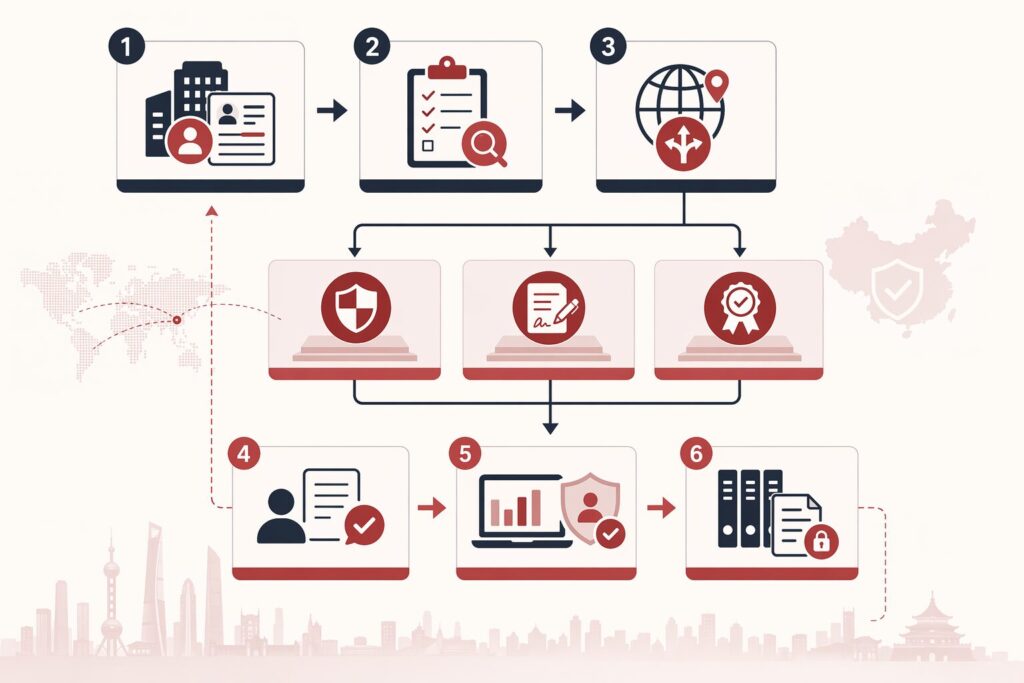
How should an enterprise handle China data export compliance in 2026? The practical answer is to treat every cross-border data flow as a governed workflow: identify the outbound scenario, classify the data, choose the right compliance path, complete notice and separate consent where required, run a personal information protection impact assessment, sign the required legal documents, and keep the process under continuous review.
This guide is based on the July 2026 policy Q&A published by Chinese cyberspace regulators and turns the official answers into an operational checklist for IT, security, legal, HR, and business teams. It is not a substitute for legal advice, but it gives enterprise teams a concrete starting point for internal assessment and implementation planning.
Who Should Read This
- IT compliance owners, legal teams, DPOs, and security leaders in foreign-invested or joint-venture companies in China
- Chinese multinational companies regularly transferring employee, customer, supplier, or operational data to overseas headquarters
- SaaS, cloud service, cross-border ecommerce, and shared service teams that support data flows across jurisdictions
- Teams preparing a data export security assessment, standard contract filing, or personal information export certification
Step 1: Decide Whether the Scenario Is a Data Export
A data export is not limited to physically moving a database overseas. In practice, it may include sending personal information to an overseas server, allowing an overseas affiliate to access a China-based system, uploading China-collected employee or customer data into a global HR, CRM, or ERP platform, or exposing local user data through APIs or SDKs that make the data available outside China.
The first control should therefore be an inventory of outbound scenarios. For each scenario, record the business purpose, system owner, data subjects, data categories, receiving party, destination jurisdiction, access method, and expected retention period.
Step 2: Classify the Data and Choose the Compliance Path
| Data Type | Common Trigger | Core Obligation |
|---|---|---|
| General personal information | Provided to an overseas recipient | Notice, separate consent where applicable, and a valid export mechanism |
| Sensitive personal information | Provided to an overseas recipient | Notice, separate consent, necessity explanation, and a valid export mechanism |
| Important data | Provided overseas | Data export security assessment |
| Critical information infrastructure data | Provided overseas | Security assessment and stricter local storage expectations |
Most enterprise teams need to compare three routes: a data export security assessment, a personal information export standard contract, or personal information export certification. The right route depends on the data type, volume, sensitivity, role of the data processor, and regulatory thresholds that apply to the scenario.
Step 3: Complete Notice and Separate Consent
When personal information is exported, the enterprise should be able to explain the overseas recipient, contact method, processing purpose, processing method, categories of personal information, and how individuals can exercise their rights with the overseas recipient.
- Do not bury cross-border transfer consent inside a generic employee or customer agreement.
- Keep evidence of the consent flow, including version, timestamp, system, and data subject scope.
- For sensitive personal information, document the necessity of the export and the potential impact on individual rights.
Step 4: Run a Personal Information Protection Impact Assessment
A useful impact assessment is not just a compliance checklist. It should evaluate whether the export purpose is lawful, legitimate, and necessary; whether the data scope is minimized; whether the overseas recipient can provide adequate protection; whether individuals have effective rights channels; and whether the organization has incident response controls for the outbound data flow.
For example, sending candidate resumes to an overseas headquarters may be unnecessary if the overseas team does not participate in the China hiring decision. If the overseas headquarters does directly participate, the exported fields should be limited to what the decision actually requires.
Step 5: Sign the Required Legal Documents
The contract or legal document with the overseas recipient should describe the export purpose, processing method, data scope, security obligations, incident notification, individual rights support, dispute resolution, and applicable legal commitments. The operational mistake to avoid is signing a document that looks complete but is not mapped to the actual systems and data flows.
Step 6: Build Continuous Compliance Operations
- Data export register: track each outbound scenario, data category, compliance route, approval status, owner, and expiry date.
- Regular review: reassess when the purpose, data scope, overseas recipient, system, or access method changes.
- Incident response: define notification, containment, investigation, and remediation steps for cross-border data incidents.
- Renewal management: monitor security assessment validity and prepare extension work before the deadline.
Common Mistakes
- Assuming group sharing is not an export. Internal transfers to overseas affiliates can still be regulated data exports.
- Focusing only on server location. Overseas access to a China-hosted database may still create a cross-border data scenario.
- Using one broad consent for everything. Personal information export usually requires specific and separately captured consent.
- Ignoring important data uncertainty. If the data may be important data, classify it properly and seek specialist support before proceeding.
- Forgetting renewal timelines. Teams should track assessment validity and extension requirements instead of discovering expiry during an audit.
Enterprise Checklist
- [ ] Identify all systems and business processes that may export data.
- [ ] Classify the data by personal information, sensitive personal information, important data, and system ownership.
- [ ] Map each outbound scenario to a compliance route.
- [ ] Complete and archive impact assessment materials.
- [ ] Prepare notice and separate consent mechanisms where required.
- [ ] Sign appropriate legal documents with overseas recipients.
- [ ] Complete filing or assessment procedures with the relevant authority when required.
- [ ] Maintain a data export register and review calendar.
- [ ] Monitor changes in recipient, purpose, scope, system, or destination.
- [ ] Keep evidence ready for audit, renewal, and incident response.
FAQ
How long is a data export security assessment result valid?
Under the current regulatory framework referenced in the July 2026 Q&A, a passed assessment result is valid for three years. If the enterprise needs to continue the data export and no re-application trigger has occurred, it may apply for an extension before the validity period expires, subject to the applicable conditions and regulator approval.
Can China candidate resumes be sent to an overseas headquarters?
It depends on necessity. If the overseas headquarters does not participate in the China hiring decision, exporting the resumes may lack necessity. If it does participate, the enterprise should minimize the exported fields and complete the required compliance steps.
Does a standard contract require approval?
A standard contract route is generally not the same as a prior security assessment approval, but it still requires proper documentation and filing procedures. The company should confirm the applicable route and local filing requirements before transfer.
How DELine Helps
DELine helps enterprise teams turn data export compliance into an executable security and governance workflow. Our work can cover data asset discovery, classification and grading, outbound scenario assessment, compliance path planning, technical controls such as encryption and access logging, impact assessment support, audit evidence preparation, and continuous operations.
If your organization is preparing a China data export compliance project, DELine can help run a focused one-day process diagnosis or a complete compliance implementation plan. Contact us through DELine to discuss the right path for your systems and business model.