The login path matters as much as the MFA prompt
Multi-factor authentication is an important safeguard for remote access, but its effectiveness depends on more than the strength of the second factor. Every enabled route into the same service must enforce the intended authentication policy. A fallback method that reaches the same VPN without the expected identity checks can undermine the design.
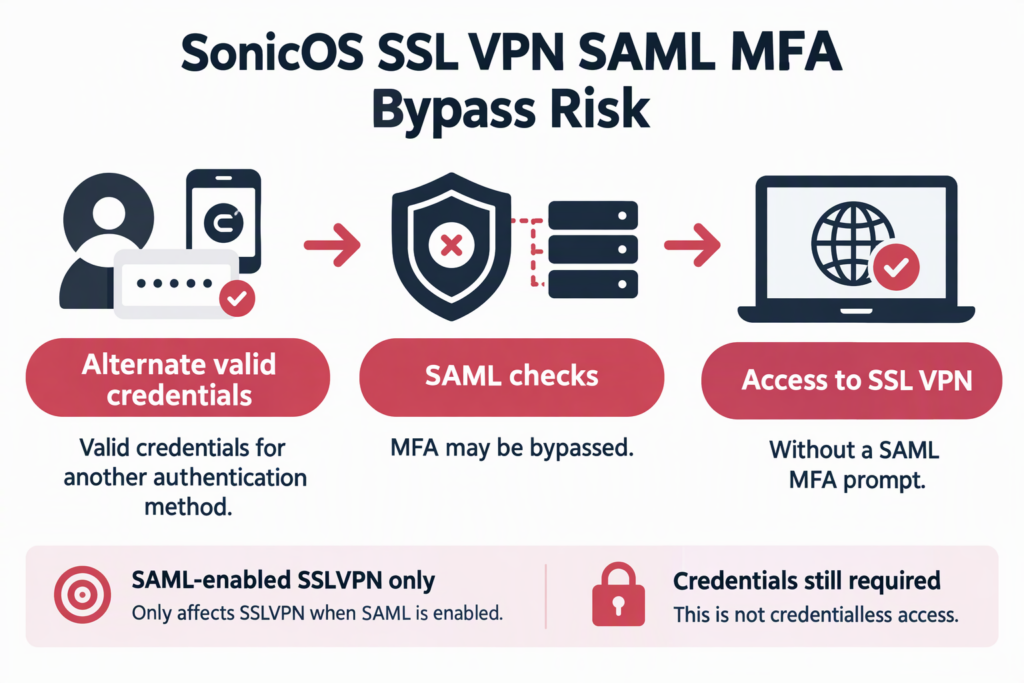
That is the concern raised by CVE-2026-19868 in SonicWall SonicOS SSL VPN. SonicWall and CISA describe an authentication-enforcement flaw that may let a user with valid credentials for an alternate authentication method bypass SAML authentication controls. If SAML is enforcing MFA, successful exploitation may also avoid that MFA check.
The boundary matters: SonicWall says the issue affects the SonicOS SSLVPN interface or service only when SAML is enabled for SSLVPN logins. The published description does not say that an attacker can log in without credentials, nor that every SonicWall deployment or every MFA implementation is affected. Teams should verify device generation and firmware, whether SSL VPN uses SAML, and which other authentication methods remain enabled.
What CISA’s KEV listing means for prioritization
CISA added CVE-2026-19868 to its Known Exploited Vulnerabilities (KEV) Catalog on November 6, 2026. The catalog entry lists a November 20 due date. That date should not be read as a universal statutory deadline for every private organization. CISA says the vulnerability-management requirements in Binding Operational Directive 26-04 apply to Federal Civilian Executive Branch (FCEB) agencies; other organizations should set remediation timing according to their own obligations, exposure, and risk.
The SonicWall PSIRT advisory says the vendor investigated a report indicating potential exploitation. That wording should remain distinct from a confirmed compromise at any particular organization. CISA’s KEV inclusion makes the issue a high-priority vulnerability-management item; it does not identify a specific victim or prove that a given firewall has been breached.
Inventory devices and authentication routes together
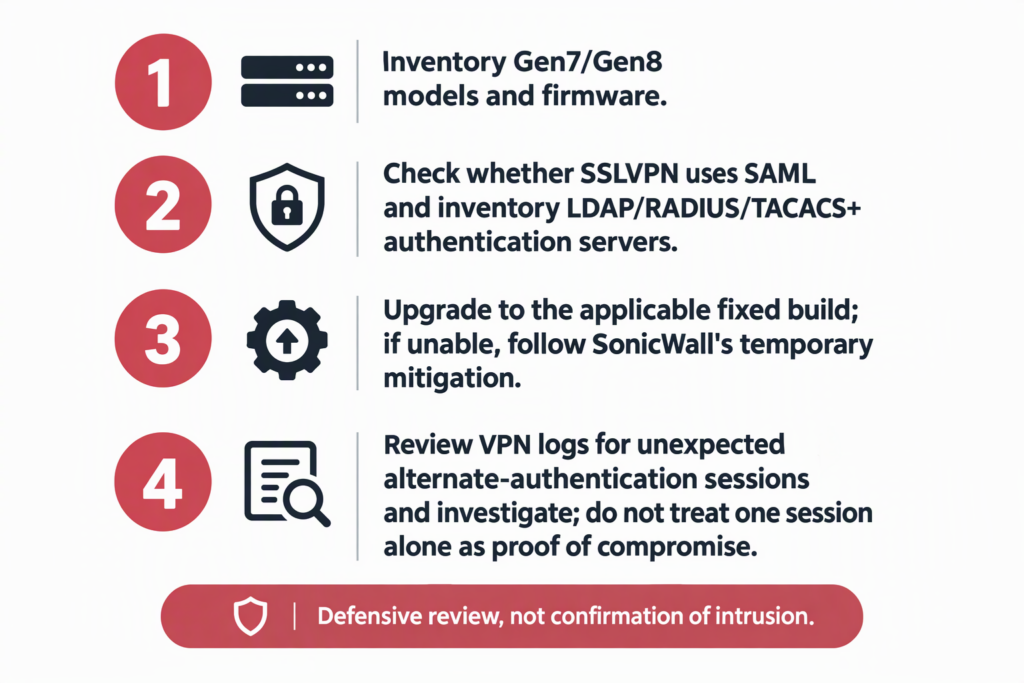
Do not stop at searching for a firmware version. For each SonicWall Gen7 or Gen8 device, record the model, installed SonicOS release, whether it provides SSL VPN, and whether SAML is configured for those logins. Then inventory the enabled authentication servers and alternate methods, including LDAP, RADIUS, and TACACS+, and establish which users or remote-access workflows depend on them.
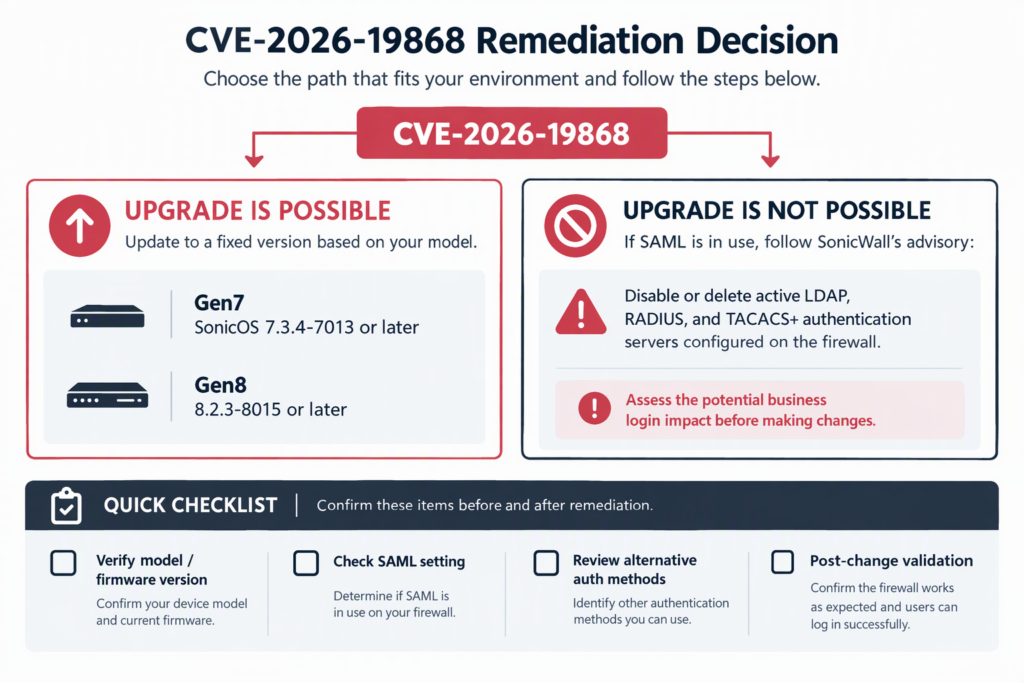
SonicWall’s advisory lists the fixed releases: Gen7 should be upgraded to SonicOS 7.3.4-7013 or later; Gen8 should be upgraded to 8.2.3-8015 or later. Match the exact model and platform to the vendor’s affected and fixed-version table rather than assuming that every device in a generation has the same upgrade path. Before an upgrade, follow the organization’s change process: back up the configuration, check compatibility, schedule a maintenance window, and verify both remote access and identity policies afterward.
If an immediate upgrade is not possible
The SonicWall PSIRT advisory lists a workaround for cases where SAML authentication is in use and a firmware upgrade is not possible: disable or delete active LDAP, RADIUS, and TACACS+ authentication servers configured on the firewall. Before applying it, determine whether those servers support other business-critical logins. Disabling them may affect legitimate users, so involve the service owner, plan communications and rollback, and verify the resulting configuration.
Do not reduce this instruction to “turn off MFA” or assume that merely disabling SAML resolves the risk. Nor should advice from a third-party article be presented as a vendor-confirmed mitigation. If the vendor’s workaround cannot be applied immediately, the security team can separately assess exposure-reduction measures—such as narrowing SSL VPN access or pausing nonessential remote access—according to the environment. Such measures are organizational risk controls, not substitutes for the vendor’s patch guidance.
Review logs after remediation
Installing a fixed release does not replace investigation. Review SSL VPN authentication logs for the relevant period. Look for successful sessions that used a method other than SAML where policy expected SAML, then correlate the account, source address, time, device, and subsequent activity. Follow the organization’s incident-response process if evidence warrants credential rotation or session revocation. A single non-SAML login does not, by itself, prove exploitation; unexplained differences between policy and actual authentication paths still deserve investigation.
Keep an auditable record of the device inventory and firmware, SAML settings, alternate authentication methods and their owners, the time of the upgrade or mitigation, validation results, the log-review period, and any exceptions. That provides evidence that the response covered the real login paths—not just that a firmware installation was completed.
Treat MFA as part of a complete access-control chain
The lesson is not to abandon MFA. It is to verify that every route into a network applies the expected identity checks and policy. Remote-access gateways, backup login methods, account-recovery processes, and exceptions all belong in the same access review and change-management process.
Organizations can use this incident to test whether remote-access inventories, authentication policies, and log retention remain aligned. For critical appliances, define patch priorities, approval paths for temporary mitigations, and a repeatable process for investigating anomalous sessions. DELine can help assess network-security devices and identity-access policies, map remote-access paths, and plan upgrades and ongoing operations within an organization’s IT environment. Visit DELine or contact our team to discuss your requirements.