If you have recently noticed security keywords such as Dirty Frag, Linux local privilege escalation vulnerability, Linux zero-day vulnerability, or CVE-2024-XXXX, you’ve already sensed the danger. Linux has long been regarded as a stable, reliable, and sufficiently secure infrastructure core: cloud hosts run it, container platforms depend on it, databases, web services, CI/CD environments, and even security devices are built on Linux. But the problem lies exactly here — once vulnerabilities like Dirty Frag emerge, the risk is no longer just about “a machine being compromised” but potentially an ordinary user account escalating to root, breaking container isolation, lateral movement, and even shaking the entire business environment.
The most troubling aspect of this kind of vulnerability is not the intimidating name, but its “real-world practicality”: attackers may not need complex remote exploit chains; sometimes just a low-privilege account, a foothold inside a container, or limited execution opportunities can leverage kernel flaws to escalate privileges. In other words, many organizations actually face not “whether someone can break in,” but “once inside, can Dirty Frag and similar Linux kernel vulnerabilities be quickly exploited to obtain the highest privileges?” This article systematically dissects the threat profile of Dirty Frag from risk background, technical logic, real harm, remediation steps, and defense strategies, helping you assess if your environment is exposed to danger.
Dirty Frag is classified as a Linux local privilege escalation vulnerability, but the term “local” often misleads many administrators. Many think “local” means you must first log in to the machine, so the risk should be limited. Reality is not so optimistic. Modern attack chains are multi-stage and integrated: web app vulnerabilities, weak passwords, CI/CD credential leaks, container image poisoning, third-party component flaws may give attackers a very low-privilege foothold. Once successful, vulnerabilities like Dirty Frag as Linux zero-day can be “the last push” to escalate ordinary privileges directly to root.
The impacted scope is broad, covering many mainstream Linux distributions across kernel versions spanning 5.x and 6.x, meaning vast numbers of production environments, cloud-native nodes, virtualization hosts, and even dev/test platforms may be affected. Kernel vulnerabilities are harder to fix than individual application services; the kernel layer is core, and any flaw weakens the trusted boundary.
Container environments are particularly worrying. Many teams mistakenly think “running inside a container is inherently safer,” but container isolation depends on kernel correctness. If Dirty Frag lets a low-privilege process inside a container escape, the problem goes beyond individual pods to threaten the host. In Kubernetes, multi-tenant PaaS, and edge scenarios, this risk multiplies. A seemingly limited container can, through kernel privilege escalation, access host credentials, keys, and cluster tokens—very serious consequences.
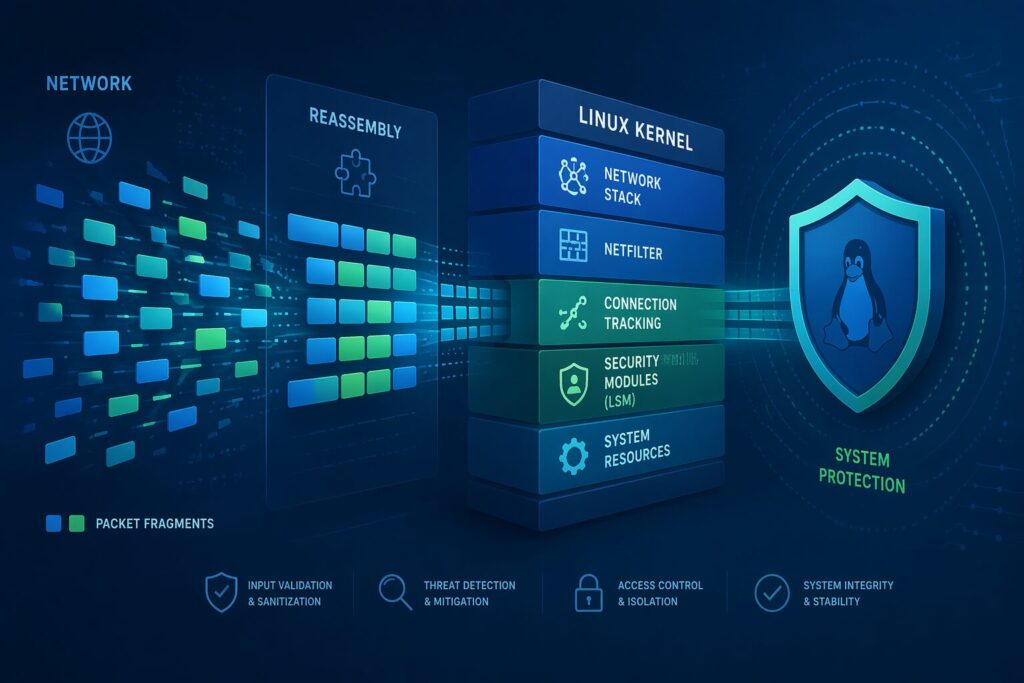
The key to defense is patching promptly. Linux kernel updates fixing Dirty Frag have been released in versions 6.6.8, 6.5.20, 5.15.146, etc. Temporary mitigations like filtering abnormal fragmented packets or limiting RAW socket capabilities can reduce risk but not eliminate it. Detection should cover host, network, and kernel behavior, with tools like eBPF providing detailed observability.
Dirty Frag’s real danger is not just privilege escalation but the chain reaction—from ordinary account to root, then potentially container escape, node compromise, cluster lateral movement, and more. Attackers with root can read sensitive files, implant persistent backdoors, shut down security agents, and erase audit logs.
• For single Linux servers: high risk—local privilege escalation and persistent compromise; immediate remediation needed.
• Container hosts and multi-tenant cloud platforms: extremely high risk—container escape, cluster-wide breaches; highest priority to patch.
• Development and test environments: medium-high risk—credential theft and supply chain pollution; repair as soon as possible.
• Edge nodes and IoT Linux devices: high risk—hidden persistence and remote control chains; urgent handling advised.
Common FAQs clarify Dirty Frag is a local exploit needing initial access, why local privilege escalations are dangerous in chained attacks, the heightened threat to container environments, why firewall-only defense is insufficient, how to verify affected systems, the advisability of disabling RAW sockets, the limits of EDR/HIDS post-exploit, and post-patch follow-up steps.
In conclusion, do not wait for attackers to validate your risks. When Linux local privilege escalation vulnerabilities like Dirty Frag enter wide discussion, the defense window narrows quickly. If you are evaluating Linux hardening, container security, kernel vulnerability investigation, or enterprise security operations, consider professional services such as those from Di-Lian Information Technology at https://www.de-line.net to bridge the gap between knowledge and effective risk management.
************
The above content is provided by our AI automation poster