Dark Web Intelligence: What the Global Hacker Market Is Selling in 2026
From IP maps to price lists — a deep scan of dark web data trading.
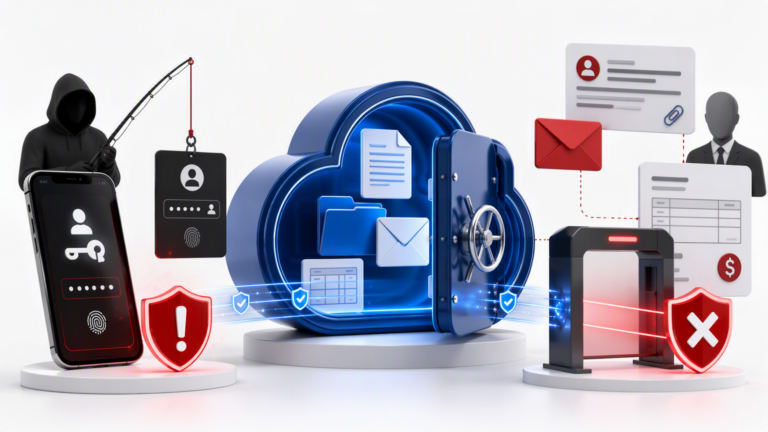
The dark web is not a vague “black market.” It is a highly structured underground economy with supply chains, pricing mechanisms, rating systems, and even customer support. This article dives into the core of dark web data trading in 2026 to reveal what the global hacker market is actually buying and selling.
Six Major Dark Web Marketplaces
The currently active mainstream dark web data trading platforms each have distinct positioning, scale, and specializations:
| Marketplace | Founded | Scale | Specialty |
|---|---|---|---|
| Russian Market | 2019 | High daily active buyers | Largest in Russian-speaking region; focuses on stolen credentials and botnet logs |
| BreachForums | 2023 (rebuild) | Six-figure registered users | Successor to RaidForums; core data leak publishing platform |
| XSS | 2013 | Top-tier Russian forum | High-end seller hub with high entry barriers |
| Exploit.in | 2005 | Longstanding Russian forum | Specializes in exploits and access credentials; longest history |
| Dread | 2018 | English-language community | Reddit-style “credit rating system” for dark web markets |
| LeakBase | 2024 | Fast-growing | Database leak search service; annual subscription model |
Key insight: dark web markets are “gentrifying.” Early dark web transactions relied on ciphers and technical barriers; today they look like e-commerce platforms with UIs, search, and reviews. Placing an order is simpler than finding a third-party seller on mainstream shopping sites.
Dark Web Price List (2026)
The following prices come from multiple threat intelligence firms’ dark web monitoring reports, spanning Q4 2025 through Q2 2026.
Personal Data
| Item | Price (USD) | Shelf Life |
|---|---|---|
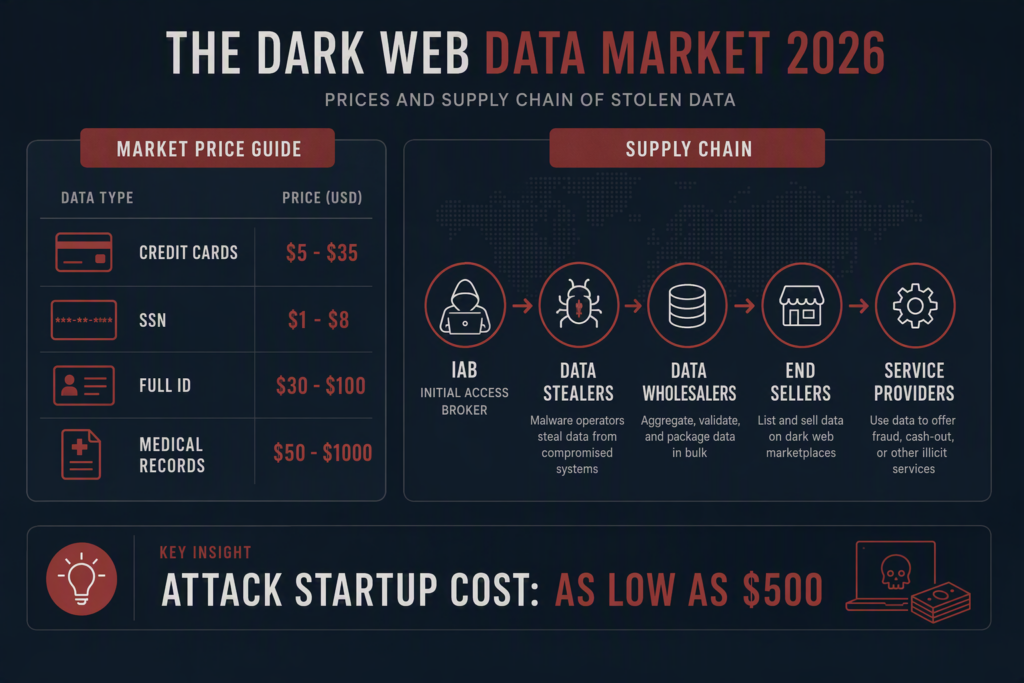
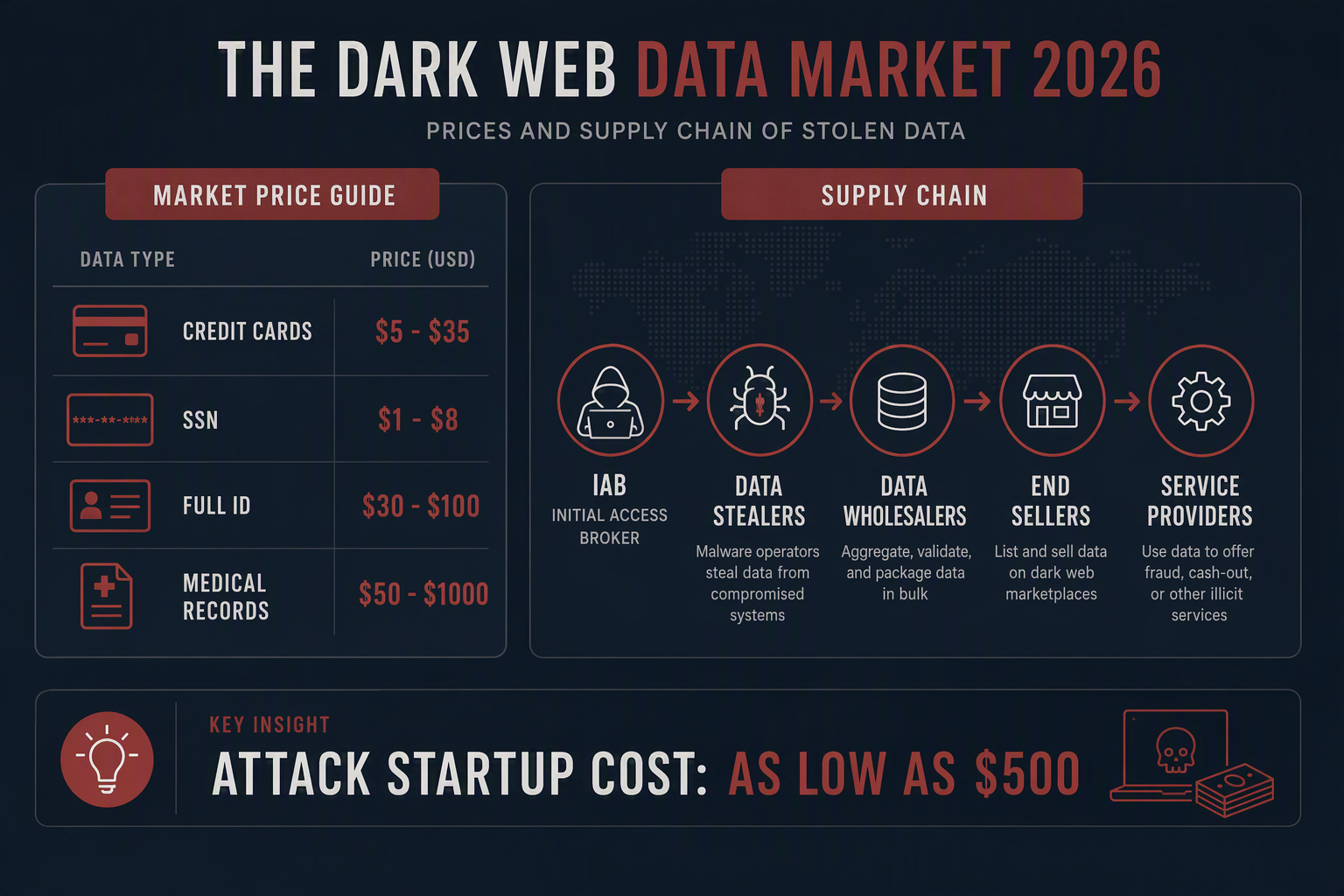
| US credit card (with CVV) | $5–35 | Until frozen |
| US Social Security Number (SSN) | $1–8 | Permanent |
| Full identity (SSN+DOB+address+driver’s license) | $30–100 | Permanent |
| Passport scan | $15–65 | Until expiry |
Enterprise Assets
| Item | Price (USD) | Shelf Life |
|---|---|---|
| Corporate email account | $20–500 | Until password changed |
| VPN/RDP access | $5–100 | Until discovered by admin |
| Citrix/VMware initial access | $500–10,000 | Weeks to months |
Tools & Services
| Item | Price (USD) | Notes |
|---|---|---|
| Ransomware-as-a-Service (RaaS) monthly | $50–1,200/month | Ongoing subscription |
| DDoS attack service (1 hour) | $10–100 | Purchase per session |
| Malware package (with anti-detection) | $500–5,000 | Weeks until detection |
Databases
| Item | Price (USD) | Shelf Life |
|---|---|---|
| Enterprise customer database (100K records) | $500–5,000 | Data currency |
| Medical record (single) | $50–1,000 | Permanent |
The most valuable commodity is medical records, not credit cards. Medical records sell for 20–200 times the price of credit cards on the black market. A credit card can be canceled and refunded — but medical history, surgery records, and drug allergies cannot be changed and have endless uses. A complete medical identity can be used for insurance fraud, prescription fraud, and even biometric fraud. It is a true “lifetime asset.”
How the Dark Web Economy Operates
Supply Chain Layers
Dark web trading is not individual behavior — it has a complete supply chain:
- Layer 0: Initial Access Brokers (IABs) — Specialize in obtaining system/network entry points and selling them to the next layer
- Layer 1: Data Stealers — Exploit entry points to exfiltrate data and package it for sale
- Layer 2: Data Wholesalers — Buy raw data in bulk, clean, classify, and price it
- Layer 3: End Sellers — List products on marketplaces for final buyers
- Layer 4: Service Providers — Money laundering, escrow, guarantee transactions, customer support
This mirrors legitimate e-commerce supply chains exactly — except the products have changed from consumer goods to personal identity information.
Credit System
Most dark web markets have an “escrow” mechanism — buyers pay the platform, which holds the funds until the product is confirmed delivered, then releases payment to the seller. Platforms charge 3–5% commission. Major sellers build “brand reputation” — counterfeit goods get exposed by the community, much like negative reviews on e-commerce sites.
This is why the dark web economy is more stable and harder to eradicate than most people imagine: it is not random hacker behavior but a market system with rules, incentives, and path dependency.
What This Means for Businesses and Individuals
For Individuals
- Your SSN/ID number sells for $1–8 on the black market — the price of a movie ticket. Most people never know theirs has been stolen.
- Password reuse is the #1 source of leaks. One site gets breached → credential stuffing attacks all your other accounts → the bundle gets sold.
- Two-factor authentication is your only effective defense. A $5 credit card can’t stop an attacker, but TOTP can.
For Businesses
- Initial Access Brokers are your biggest actual threat. Not APT groups, not “legendary hackers” — but the person selling your VPN vulnerability information for $200.
- Security budgets should be re-evaluated against “dark web pricing.” If an attack’s startup cost is only $500, your defense cost should at minimum make it uneconomical.
- Dark web exposure monitoring is table stakes. At minimum, know whether your domain, email addresses, and credentials are being openly priced on underground markets.
Core Lesson
Security is not about being “unbreachable” — it is about making your attack cost higher than the adversary’s expected gain. The dark web price list tells us that for most targets today, the cost of attack is absurdly low.
How DELine’s Security Capabilities Address This
Facing a structured, low-cost, high-efficiency underground economy, enterprises cannot rely on perimeter firewalls and antivirus alone. DELine’s cybersecurity services build defense-in-depth across three dimensions:
- Threat Intelligence & Dark Web Monitoring: Continuously track asset exposure on the dark web, including credential leaks, domain impersonation, and initial access brokering — enabling early detection and rapid response.
- Initial Access Protection & Perimeter Hardening: Security configuration audits, vulnerability management, multi-factor authentication deployment, and continuous monitoring for common entry points such as VPN, RDP, and Citrix — raising the attacker’s cost of entry.
- Security Assessment & Red/Blue Teaming: Penetration testing and simulated attacks to verify your actual exposure surface against the dark web’s attack cost baseline, providing quantified ROI for security investments.
Learn more about DELine’s cybersecurity services at www.de-line.net or contact our security advisory team.
Sources: CrowdStrike 2026 Global Threat Report, Recorded Future, Flashpoint, Chainalysis, and other publicly available threat intelligence reports.