Your API Keys Are Running Naked on Someone Else’s Server — Five Risks of AI Token Relay Services with Real Cases
The Short Answer
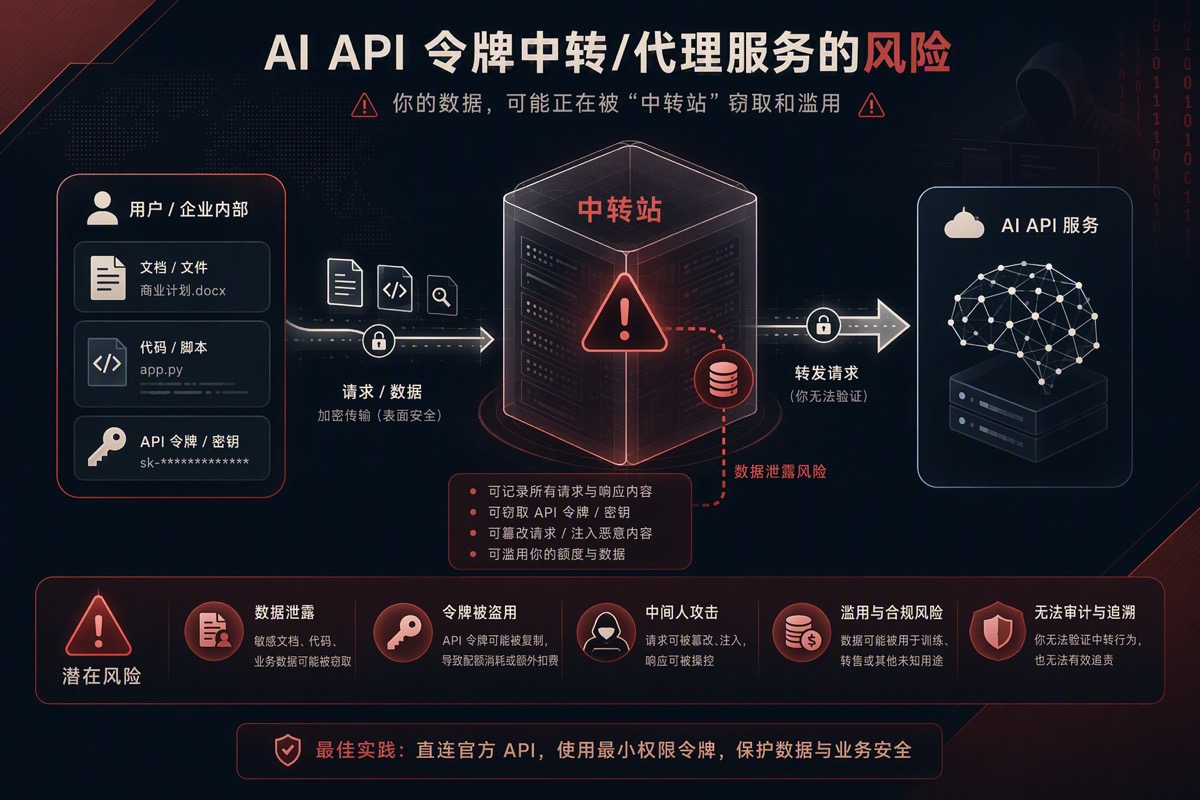
Using third-party token relay services (AI API proxy/forwarding) means every conversation, API key, and business logic passes through an unknown server that can record, analyze, and resell your data. This is not theoretical — the Allen AI WildChat project, multiple Chinese AI “wrapper” apps caught collecting user data, and OpenAI’s enforcement actions against unauthorized proxy access have all demonstrated this risk with documented cases.
Who Should Read This
- Enterprise IT and security teams using or evaluating third-party proxy access to OpenAI / Claude / Gemini
- AI application development leads weighing cost savings against security risks
- Compliance and data protection officers managing cross-border data regulations
- Procurement and vendor management professionals vetting AI service providers
What Is a Token Relay Service?
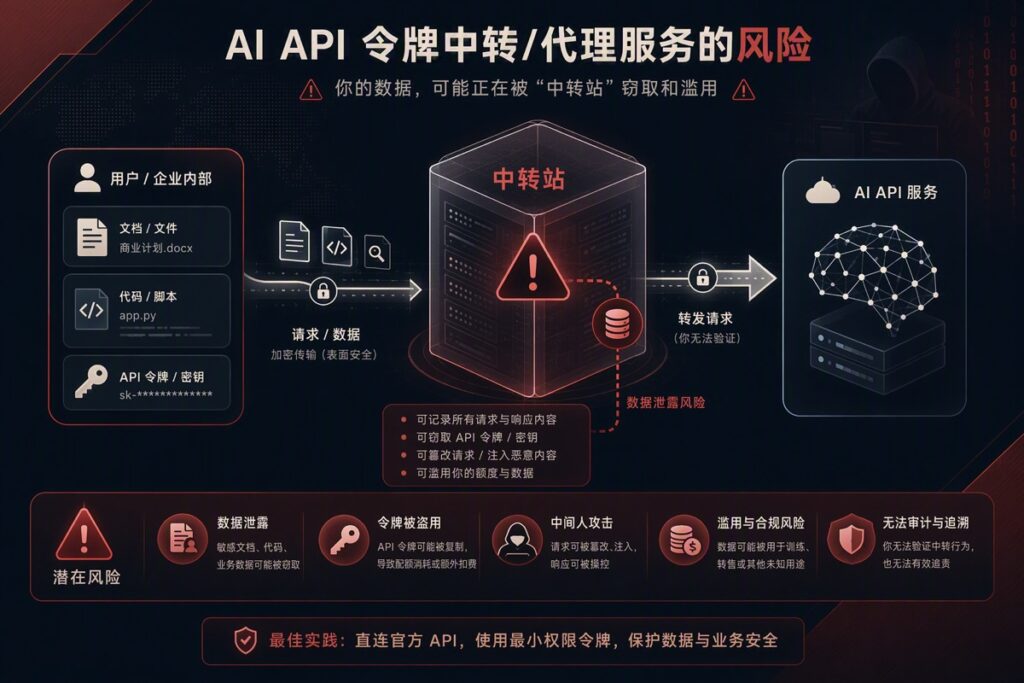
A token relay (AI API proxy/forwarding service) lets users submit their API keys to a third party that forwards requests to the original API. The typical flow: User → Token Relay Server → Original AI API → Relay Server → User
Common forms include “better connectivity” forwarding services, proxy layers in “AI Assistant” mobile apps, “cost optimization” API gateways, and cross-border API proxy services.
From a technical standpoint, every token relay is a man-in-the-middle proxy that can view, record, modify, or block every API request and response.
Risk 1: Data Leakage — Your Conversations Are a Product
Real Case 1: WildChat — Collecting 1M ChatGPT Conversations
The Allen AI research team published WildChat in 2024. They deployed a free ChatGPT interface via Hugging Face Spaces (using GPT-3.5-Turbo and GPT-4 APIs). Users agreed to data collection to use the service for free. Result: 1 million real user-ChatGPT conversations were collected, including request headers with IP addresses and device information.
Why this matters: WildChat was essentially a token relay — users accessed OpenAI through a third-party proxy, and every conversation was published as an open-source dataset.
- Scale: 1M conversations, 2.5M+ interaction rounds
- Publication: May 2024
- Source: Zhao et al., “WildChat: 1M ChatGPT Interaction Logs in the Wild,” arXiv:2405.01470
- Dataset: Hugging Face datasets/allenai/WildChat
Real Case 2: “AI Wrapper” Apps Uploading User Data
Throughout 2023-2024, mobile security labs (including 360 Security Lab, Tencent Xuanwu Lab) exposed dozens of Chinese apps that claimed “self-developed AI” but were simple OpenAI API wrappers. These apps secretly collected device information, location data, and contact lists alongside AI conversations for user profiling and ad targeting.
- Scope: Dozens of “AI Assistant” and “AI Writing” apps
- Data: Conversations + device fingerprint + location + contacts
- Outcome: Some apps removed from app stores
- Sources: Multiple security lab reports (2023-2024)
Real Case 3: API Key Theft Through Proxy Services
The OpenAI developer community has documented numerous cases where users registered for proxy services only to find their API keys used without authorization. Operators shared keys across multiple nodes or sold them to third parties, generating tens of thousands of dollars in unauthorized charges.
- Pattern: Register proxy → Submit API key → Key shared → Massive bill
- Sources: OpenAI developer forum, V2EX, Reddit r/ChatGPT
- Timeline: Ongoing since 2023
Risk 2: Compliance Violations
OpenAI’s Usage Policies explicitly prohibit accessing the API through unauthorized third-party intermediaries. Consequences include account termination with no refund and loss of all data and fine-tuned models.
When data passes through a token relay, it may also violate China’s Personal Information Protection Law, GDPR Chapter V on cross-border data transfers, and China’s Data Security Law.
Risk 3: Unreliable Service
Documented issues include model downgrading (users paying for GPT-4 but receiving GPT-3.5), content injection (ads and tracking), and service outages lasting over 48 hours when OpenAI changed IP policies in 2024.
Risk 4: Supply Chain Attack Surface
Relay compromises give attackers access to all customer data. Some relay SDKs were found containing malicious code exfiltrating user data. Relays may resell access to fourth and fifth parties.
Risk 5: Hidden Costs
$10 in actual OpenAI fees becomes $15-30 through relays. Key sharing causes excess charges. Account bans lose prepaid balances and engineering investment.
Enterprise Alternatives
- Azure OpenAI Enterprise Direct Connection — end-to-end encrypted, data stays within tenant boundary, Private Endpoint support. DELine provides full deployment support.
- Enterprise AI Gateway — unified management with audit, masking, cost control, and access control.
Sources
- Zhao et al., “WildChat: 1M ChatGPT Interaction Logs in the Wild,” arXiv:2405.01470, May 2024. https://arxiv.org/abs/2405.01470
- WildChat Dataset: https://huggingface.co/datasets/allenai/WildChat
- OpenAI Usage Policies: https://openai.com/policies/usage-policies/
- Microsoft Azure OpenAI Data Privacy: https://learn.microsoft.com/en-us/legal/cognitive-services/openai/data-privacy
- China Personal Information Protection Law (2021)
- GDPR Chapter V
- Mobile security lab reports on AI wrapper apps (360, Tencent Xuanwu, 2023-2024)
How DELine Can Help
DELine, as a Microsoft partner, offers enterprise AI security access services including Azure OpenAI compliance assessment and deployment, enterprise AI gateway design, AI security risk assessment, and cross-border data compliance consulting.
Visit https://www.de-line.net or contact us at https://www.de-line.net/contact-us/.