Should AI Run Your Factory Schedule? — It Can, But Not How You Think
In 2001, Nike spent hundreds of millions on an algorithm-driven supply chain planning system. Best-sellers went out of stock, slow-movers piled up, and the stock dropped nearly 20% in a single day. Twenty-five years later, the same story is playing out in boardrooms — this time with AI as the protagonist.
Every Technology Wave Asks the Same Question
Manufacturing scheduling has an open secret: with every new technology wave, someone believes this time the production planner can be replaced.
Twenty-five years ago it was APS. Ten years ago, smart manufacturing. Today, AI. The tool changes, but the question never does. A CEO walks in and asks, “Can AI just run my schedule for me?” — it sounds like a 2025 question, but swap “AI” for “APS” and it’s word-for-word what executives asked in 2000.
Let’s be clear about what’s wrong with this question first, then talk about what actually works. Getting this wrong costs more than just software licensing.
Why “Just Let AI Do It” Is a Dead End
Start with the conclusion: letting AI directly generate a production schedule isn’t “not good enough yet” — it’s fundamentally the wrong approach.
Factory scheduling is a mathematical problem called job-shop scheduling, and it has a nasty characteristic: once the number of orders and machines exceeds a threshold, the number of feasible solutions explodes exponentially. Thirty machines and two hundred work orders produce more possible schedules than there are atoms in the universe. Finding one that satisfies every physical constraint while minimising delay requires dedicated constraint-solving algorithms — pruning and searching toward an optimal solution. It does not rely on “intelligence” or “understanding.”
Large language models work in exactly the opposite way. They predict the most likely next token based on patterns in training data. When you ask it to schedule, it produces something that looks like a schedule. Columns align, timelines look coherent, the formatting is professional. But it has verified exactly zero constraints. It doesn’t check whether Line 3 actually has the capacity to run those orders in that hour, or whether two work orders need the same tooling. It hands you a document that looks plausible — and is almost certainly unexecutable.
Two more dealbreakers:
- Not reproducible. Feed the same data twice, get two different schedules. Production scheduling cannot tolerate randomness — if today’s plan differs from yesterday’s, the shop floor doesn’t know whose to follow.
- Not traceable. It cannot tell you why it made a particular decision. Scheduling requires full traceability: every tool change, every priority rule must be explained, reviewed, and improved upon.
It’s like hiring a consultant who sounds brilliant in every meeting, only to discover equipment collisions, missing materials, and delayed orders when you actually execute — and they can never explain why they recommended what they did.
AI’s Real Role: Translator, Not Decision-Maker
But there’s another side to this.
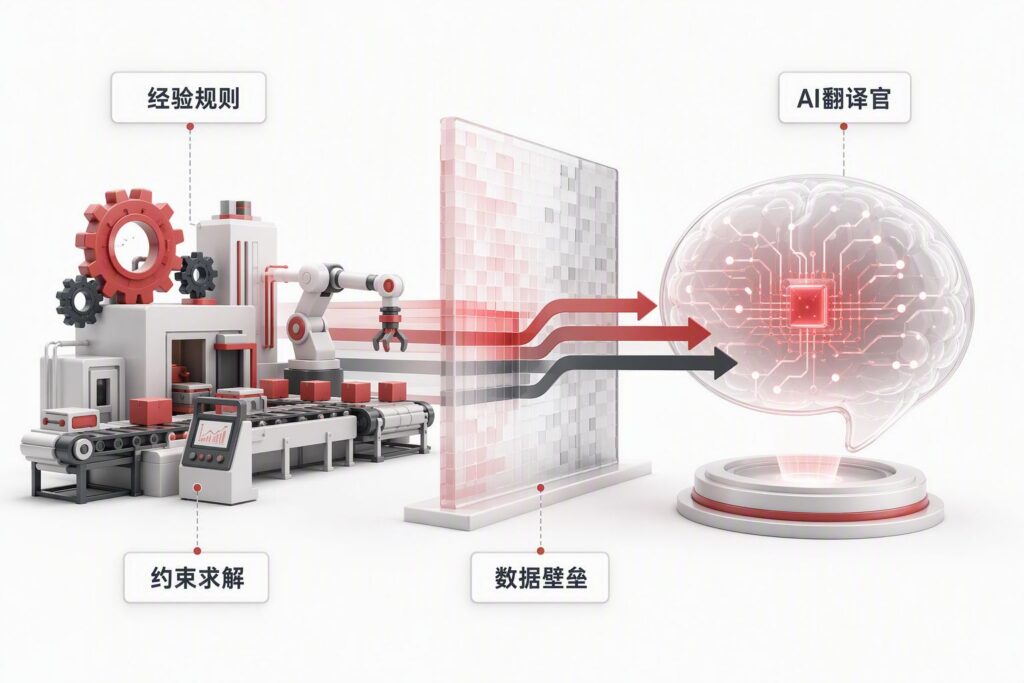
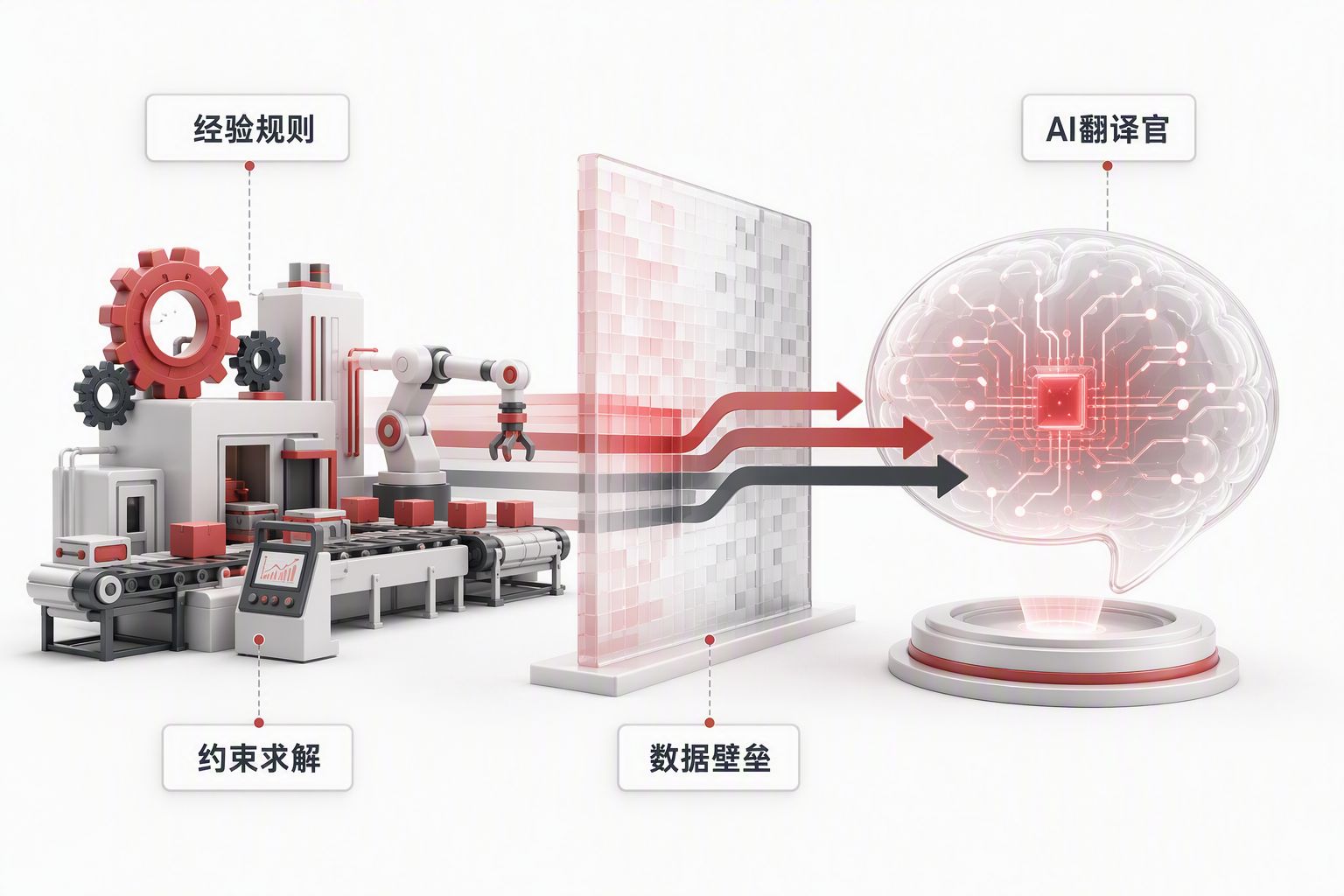
AI shouldn’t be the one doing the math. It should be the one building the system that does the math. This distinction determines where your investment goes.
The tools that actually “compute” have existed for decades. Google’s OR-Tools (especially its CP-SAT solver) is free and open-source. Siemens Opcenter APS and SAP’s Advanced Planning modules have been commercially available for years. They are mathematically sound, reproducible, and can prove how far the current solution is from the theoretical optimum.
What manufacturers actually lack isn’t solvers — solvers are everywhere, many of them free. What’s missing is the ability to translate shop-floor rules into a form solvers can understand. Historically, this was prohibitively expensive: buying a million-dollar APS was just the entry ticket. The real cost was hiring a modelling consultant who could listen to a veteran machinist say “these two jobs should run back-to-back” and write it as a constraint equation. Most factories didn’t fail at buying APS — they failed at building the model, and went back to Excel.
This is exactly where AI changes the game:
You tell it: “Jobs with a changeover time over 40 minutes should be grouped together.” “VIP orders must be finished three days before the deadline.” “This machine needs maintenance after eight continuous hours.” AI translates each of these human-language rules into OR-Tools constraint code. It pulls work orders from ERP, reads real-time equipment status from MES, and wires the data pipeline together. When the solver finishes, you ask “Why is order five at the end of the schedule?” — AI traces back through the constraints and tells you exactly which rule pushed it there. A new rule tomorrow? One sentence, and AI updates the model and recalculates.
The division of labour is straightforward: the solver handles mathematical optimisation; AI handles the translation between humans and the solver. It doesn’t replace the planner — it puts modelling capability, once locked inside million-dollar software and expensive consultants, into the hands of the factory team.
Three Fault Lines, Each Harder Than the Last
If the problem were just “choose the right tool and divide the work properly,” this would have been solved years ago. The reality is that most manufacturing scheduling digitisation projects work technically but fail organisationally.
The cause isn’t technology. It’s three fault lines, each deeper than the last.
Fault line one: data. Feed garbage into even the most powerful solver, and you get precisely amplified garbage. MES equipment status might be three days old. BOM cycle times are estimates. Inventory records don’t match physical stock. The problem isn’t that the algorithm isn’t good enough — it’s that basic input trustworthiness hasn’t been established.
Fault line two: rules. The constraints that actually drive scheduling decisions — the majority of them — exist in no document. They live inside the heads of a few veterans with twenty years of experience. “This job needs Lao Wang watching it.” “That machine’s precision drifts in rainy weather.” “This customer’s orders seem low priority but they chase hardest.” AI can help surface these rules and encode them — but it cannot extract knowledge the veterans themselves don’t know they have, the kind that lives only in gut feel.
Fault line three: authority. This is the hardest one. A production schedule is, at its core, a document that allocates power — it decides who goes first, who waits, whose work gets preempted. The veteran’s schedule is followed not because it is mathematically optimal, but because the shop floor respects his authority. Push an algorithm-generated schedule that nobody trusts, and the foreman says “the machine doesn’t know what it’s doing.” The perfect schedule becomes a piece of paper nobody looks at.
AI can help blast through the first two fault lines. It cannot touch the third — because that is not a technology problem. It is a “who calls the shots on the shop floor” problem.
What a CEO Should Actually Do: Four Steps
If you are the decision-maker considering AI for scheduling, here is a path that works:
Step one: pick one line, not the whole plant. Choose a production line with clear constraints and relatively clean data. Trying to roll out across the entire factory from day one is a recipe for nothing moving forward.
Step two: let AI help you “write down” the rules. The real value here may exceed the schedule itself. Turning decades of veteran experience into discussable text and modifiable code — this is the first time the company transforms scheduling knowledge from personal expertise into organisational asset. Even if AI never runs a single schedule, this step alone is worth doing.
Step three: run algorithm and veteran side by side. Don’t publish the AI schedule to the floor yet. Run it parallel with the veteran’s version. Have the planner and line supervisor compare daily: where the algorithm genuinely outperforms, and where it missed something only a human would catch. This phase isn’t training the AI — it’s training the team to understand the algorithm’s logic and build trust.
Step four: solve the “who decides” problem. Moving from “the veteran scheduled it, do it” to “the rules we all defined produced this schedule, do it” — this is not a technology upgrade, it is organisational change. The CEO must drive it personally; planning and production managers must define the rules together. AI has lowered the cost of this transition to the lowest point in history, but the decision ultimately rests with people.
DELine’s position is straightforward: Most manufacturers’ scheduling problems are not caused by a lack of computing power. They are caused by three things — data that cannot be trusted, rules that cannot be seen, and authority that cannot be transferred. The first two, AI can finally address at an affordable cost. The third, technology can only put the choice on the table.
That schedule: are you willing to let it replace the veteran’s call? Your answer determines how far you can go with this.
If your organisation is evaluating AI for production scheduling, DELine offers end-to-end services from current-state assessment and scheduling rule discovery through OR-Tools modelling to pilot line deployment. Reach us at www.de-line.net or via our contact page.