CVE-2026-59310: Why Patching vCenter Is Only Half the Battle
361 IPs, 47 Countries — What a Directory Traversal Vulnerability Means for Your Virtualization Layer
On August 10, 2026, German cybersecurity firm Quirso published findings that put enterprise IT teams on high alert: a critical directory traversal vulnerability in VMware vCenter, scored CVSS 9.8 and tracked as CVE-2026-59310, is being actively exploited by an unidentified APT group. As of the report, attackers had compromised vCenter systems across 361 unique IP addresses spanning 47 countries. The most heavily affected regions include Germany, the United States, Turkey, Iran, and France.
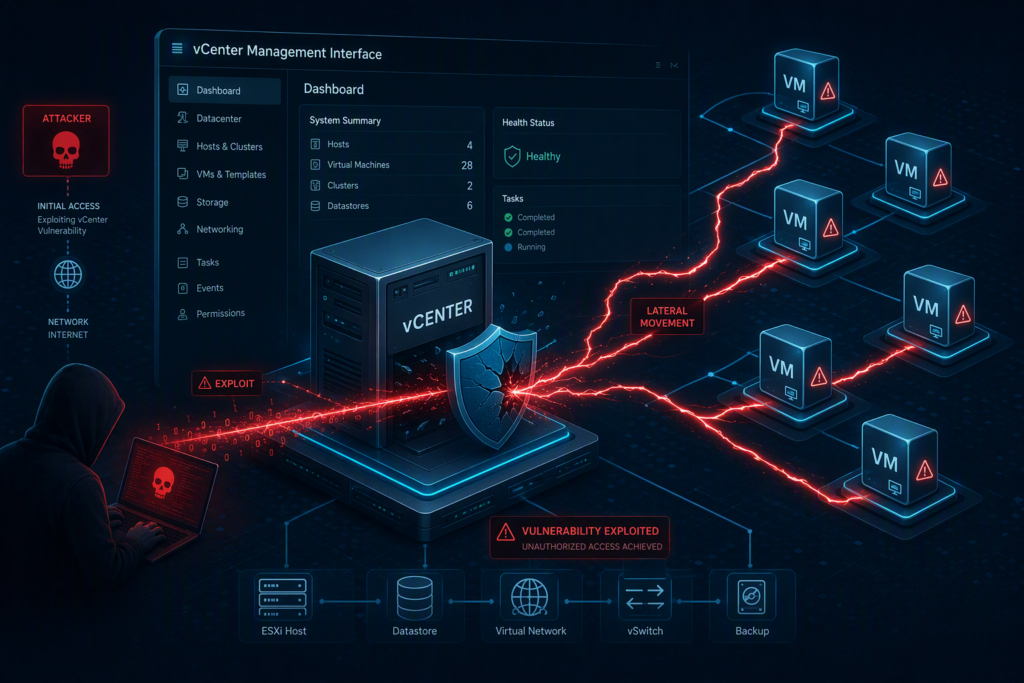
Once inside, the attackers deployed reverse SSH tunnels maintained through cron jobs — a persistence mechanism that allows re-entry through outbound connections even after the initial entry point has been patched.
This is not a targeted espionage campaign. The scale — 361 distinct IPs across 47 countries — reveals an indiscriminate sweep targeting any reachable vCenter instance. Each compromised management server becomes a staging ground for lateral movement into the virtual machines it controls.
Why a “File Read” Vulnerability Can Paralyze Your Entire Virtual Infrastructure
Directory traversal flaws are often underestimated — they let attackers read files outside authorized paths. But when the vulnerable component is vCenter, the destructiveness amplifies dramatically.
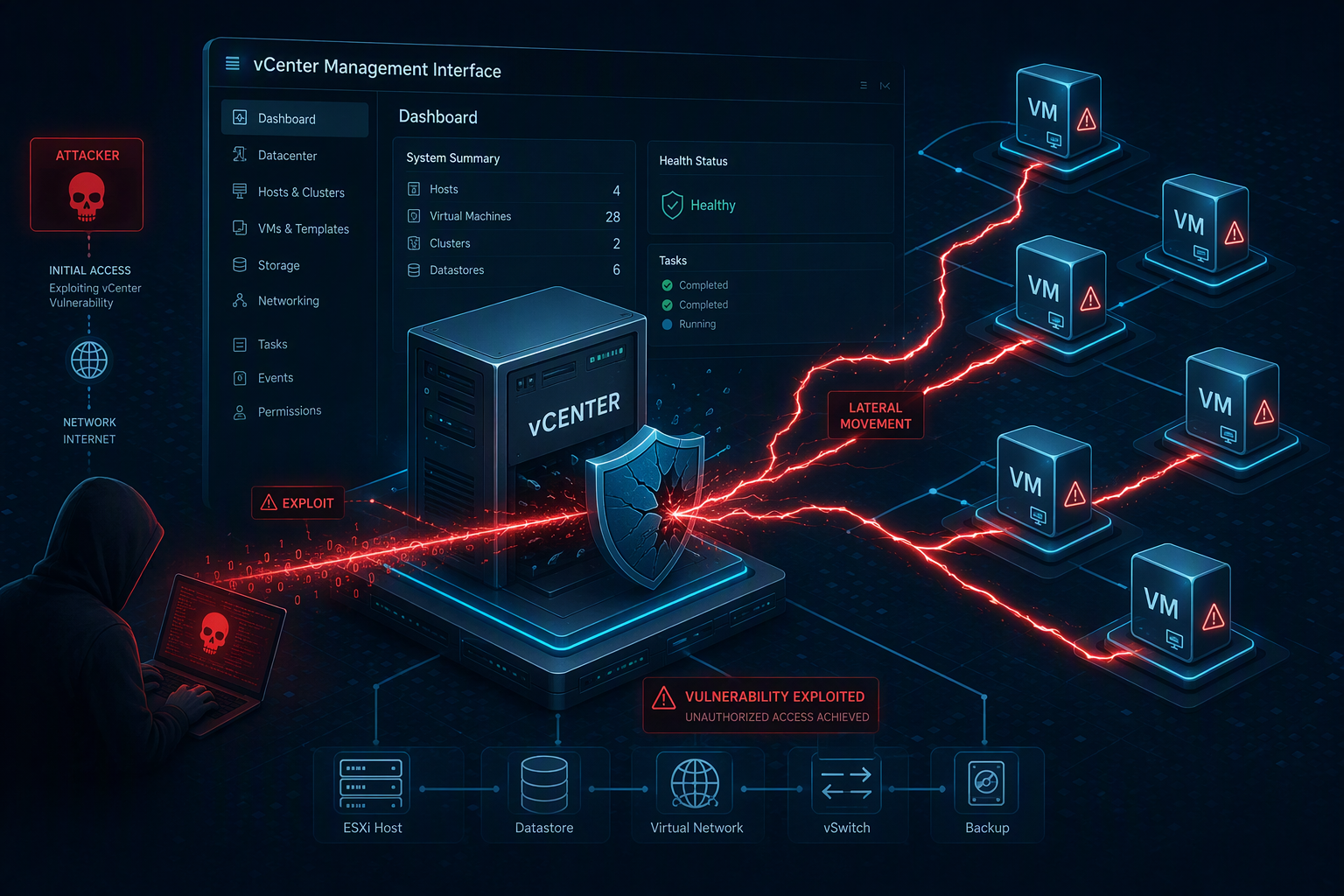
vCenter is the control plane of VMware virtualization: it manages VM creation, migration, snapshots, permissions, networking, and storage for every ESXi host under its domain. Gaining code execution on vCenter doesn’t just compromise a server — it hands over administrative control of the entire virtualization layer.
As Denis Calderone, CTO of Suzu Labs, put it: “Once vCenter is compromised, an attacker controls every virtual machine, every host, every snapshot in the environment.” The risk profile is comparable to losing a domain controller.
For IT managers, this means a component often treated as “background infrastructure requiring minimal supervision” has become one of the most critical security surfaces in the enterprise.
Attack Chain: Why “Patch the Hole” Thinking Falls Short
Quirso’s forensic analysis reveals a three-stage attack:
Stage 1 — Entry via vulnerability. The attackers exploited CVE-2026-59310’s directory traversal to execute unauthorized code on the vCenter management interface. Since vCenter typically runs with root or system-level privileges, the attackers gained full device control upon entry.
Stage 2 — Persistence deployment. A cron job was installed to maintain a reverse SSH tunnel, causing the compromised vCenter appliance to initiate outbound connections to attacker infrastructure. The critical insight: most organizations firewall inbound traffic aggressively but leave outbound connections loosely monitored. Reverse SSH exploits this asymmetry, keeping the door open even after the original entry point is closed.
Stage 3 — Lateral movement. With vCenter under control, attackers can manage every ESXi host, every VM, every snapshot, and the virtual network fabric. The impact depends on their objective — data exfiltration, ransomware deployment, or establishing a long-term foothold.
Justin Beals, founder and CEO of Strike Graph, observed: “The gap between patch release and organizational response is where every real breach lives. A vCenter compromise is never contained to one server. It’s a foothold into everything that server touches.”
Two Clocks: Patching Closes the Door — It Doesn’t Check Who’s Already Inside
Jason Soroko, Senior Fellow at Sectigo, articulated a dual-clock model every IT team must internalize:
- Clock 1 — Close the entry point. Update vCenter to the patched version immediately to block new intrusions.
- Clock 2 — Evict attackers already inside. Patches do not remove deployed cron jobs, reverse SSH tunnels, backdoor accounts, or other persistence mechanisms.
Soroko stresses: “Patching closes the entry point, but it does not remove persistence that may already exist. Teams should update vCenter, restrict access to its management services, and examine cron entries, processes, files, authentication records, and outbound connections for signs of compromise.”
For IT managers, this means a major vulnerability response cannot end with “patches have been deployed.” Patch coverage is easy to report; persistence cleanup requires incident-response-level investigation — a capability most virtualization operations teams do not have in-house.
Beyond Patch Fatigue: Reassessing Your Virtualization Architecture
CVE-2026-59310 is neither vCenter’s first serious vulnerability in 2026 nor its last. When a patch is weaponized across 47 countries within five days of disclosure, IT managers face not a one-time patching task but a structural question:
Is your virtualization architecture resilient enough to survive a control-plane compromise?
The deeper implication: if a single management component failing leads to the entire virtualization layer being compromised, does the architecture have safeguards that limit blast radius even when the control plane is breached? In traditional VMware deployments, the answer is sobering — vCenter’s full administrative access over ESXi hosts was designed for operational efficiency, but it also creates a single point of failure from a security standpoint.
How Alternative Virtualization Platforms Compare on Security Architecture
When patch fatigue combines with licensing cost pressure (Broadcom’s acquisition of VMware has brought significant pricing changes for many customers), more IT managers are evaluating alternatives. From a security architecture perspective, each option has distinct characteristics:
Microsoft Hyper-V: Hyper-V’s key architectural difference lies in management-plane exposure. Its management interfaces — Windows Admin Center and System Center — leverage Windows’ existing security framework (Group Policy, RBAC, audit policies). For organizations already invested in the Microsoft ecosystem, this reduces management complexity and ensures security policy consistency. However, Windows Admin Center is still a web-based management interface and requires certificate binding, network isolation, and MFA to mitigate similar risks.
Hyperconverged Infrastructure (HCI): HCI platforms consolidate compute, storage, and virtualization management into a unified layer. The security advantage is not “invulnerability” but attack-surface reduction — fewer components to manage, simpler network paths, and unified security policy enforcement. The management plane remains a target, but the operational surface area is smaller, reducing the likelihood of a missed patch across multiple disconnected components.
Hybrid Strategy: For organizations with substantial VMware investments, full migration may not be optimal. A hybrid approach — migrating critical workloads to Hyper-V or HCI while progressively reducing the exposed surface of legacy VMware environments — balances risk reduction with migration cost.
DELine’s Recommendations for IT Managers
The core lesson from CVE-2026-59310 is not about VMware versus alternatives — it’s that enterprises have systematically underinvested in virtualization control-plane security. Regardless of platform choice, these four measures should be baseline:
- Dedicated management network isolation. Place vCenter and management interfaces on a separate management VLAN with no direct connectivity to corporate or production networks.
- Accelerated patch response. For vulnerabilities rated CVSS 9.0+, compress the patch window from “this quarter” to “within 72 hours,” and always include post-patch persistence checks.
- Continuous attack-surface monitoring. Regularly inspect virtualization management components for unexpected cron jobs, scheduled tasks, suspicious processes, and outbound connections — especially reverse SSH tunnels, which are among the stealthiest persistence mechanisms.
- Regular virtualization architecture reviews. Every 12–18 months, assess your virtualization platform’s security posture, licensing costs, and operational efficiency — treating platform migration or hybrid deployment as a routine risk management exercise rather than a crisis-driven decision.
If you are evaluating the security resilience of your virtualized environment or exploring migration paths to Hyper-V, HCI, or a hybrid architecture, DELine offers architecture assessment, migration planning, and implementation services.
About DELine
DELine (帝联科技) specializes in enterprise IT infrastructure and cybersecurity, delivering virtualization architecture assessment and migration, security solution design, AI infrastructure deployment, and managed IT operations. The team holds system integration qualification and ISO27001 certification, serving corporate and government clients across multiple industries. Visit www.de-line.net or our contact page to schedule a consultation.